

Music notes on the staff always consist of two components:
- the pitch of the note
- the length of the note
The names of the pitches are similar to our alphabet. If you name the notes in order, starting with the note A, you get the following: A, B, C, D, E, F, G. You can find these notes both on the piano keyboard and in the notation in the illustration below.
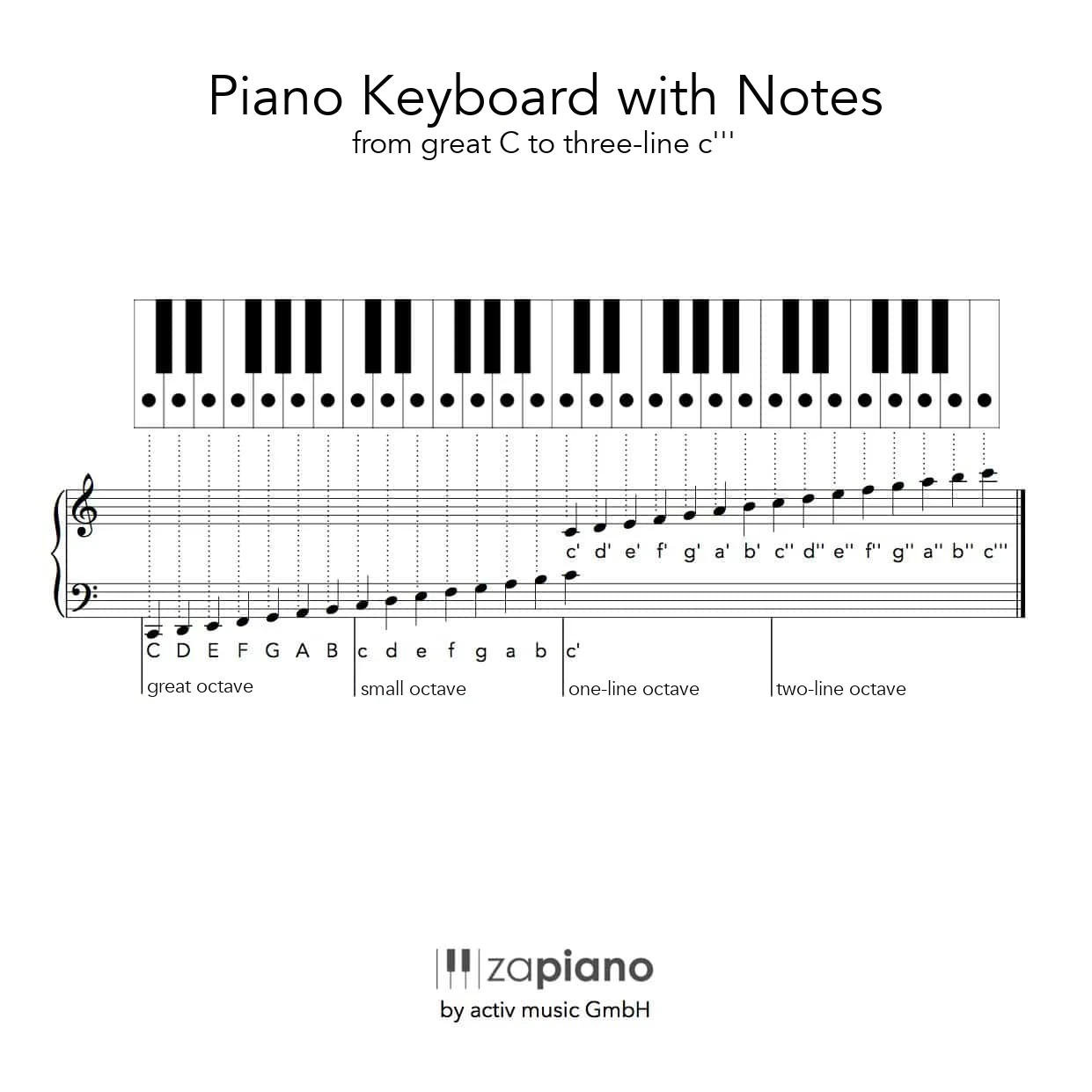
It’s best to go step by step and limit yourself to the white keys at first; we’ll leave out the black keys for now. When you start reading music, leave out the note lengths at the very beginning. A note length always means that notes not only have a pitch but also a certain duration. These are called note values. Learning to read rhythm makes things a bit more difficult, which is why we leave out this element at the very beginning.
Here you’ll find more information about note values and how best to practice them.
In the Zapiano® Method, we always treat the different topics separately while practicing. This keeps the learning units manageable and, above all, achievable within a short time. We follow a systematic structure and a multisensory learning theory that involves several sensory channels.
As soon as there is a time signature, we automatically also have to deal with the pulse (or meter). For you, this means that you should be able to recall the notes instantly. At the very beginning, however, your mind needs some time to become familiar with the individual notes and note names.
How to Start Off Right
It’s best to print out the chart above. The first step is to limit the range of notes. I always start my students on the notes from c’ to c" – that is, from middle C up to the next C. In technical terms, this range is called an octave. The notes within it are really nothing more than a C major scale.
Now it’s all about connecting each note with its letter name – this is your first practical exercise. To remember the notes, it helps to take a closer look at the staff lines.
Music notation always consists of 5 lines and 4 spaces. If you want to write notes lower or higher than that, you use so-called ledger lines. The pitch determines where each note is placed. Since the piano is a logically structured instrument, this kind of visualization is immediately understandable for most people. To begin with, leave out the rhythm completely for now – the pitch alone already contains plenty of musical information.
Reading Music Depends on the Level of Difficulty
When someone tells me they can read piano music, I only have a very vague idea of what that actually means for that person. “Reading music” is not a fixed term. It can mean “Twinkle, Twinkle, Little Star” level – or the level of a trained concert pianist. Both do the same thing, but at a completely different level of skill.
Learning to read music is a long-term process – one that basically never ends. After all, piano literature has been written for more than 300 years. That adds up to quite a lot.
Once you have taken your first steps, there are several providers that offer sheet music for download.
Learning Music Notes Made Easy with Zapiano®
When learning music notes, you can simply start with the basics. Here I’d like to show you step by step how to learn the notes in a simple yet holistic way. Sit down at your piano and simply give it a try.
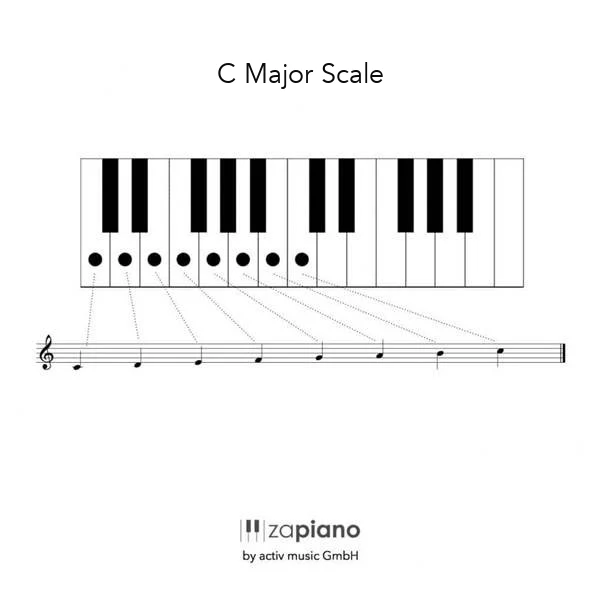
- First, take a look at the piano keyboard. At the beginning, the white keys are enough. We’ll leave out the notes on the black keys for now. You don’t need to worry about sharps and flats yet either. Match the note names C, D, E, F, G, A, B to the correct keys on the keyboard. Memorize the name of each piano key. By the way, this is the C major scale.
- Then do the same with your sheet music. Look at where the notes are on the staff. Learn which note has which name. If it’s too complicated, you can limit yourself to the notes C, D, E, F and G at first.
- Connect reading the notes with the piano keys. Look at where C is on the keyboard and where it is on the staff. Then do the same for D, E, F and G. Through practice, your image of the notes on the page links up with the notes on the keys.
- Now your hand comes into play. Place your thumb on C and play the keys D, E, F and G one after the other with your other fingers. Do this very, very slowly. This way, your brain forms a connection between what your eyes see on the sheet music and what your fingers play. Repeat this exercise again and again so that you can internalize it. It takes a little time. Be patient with yourself.
Reading Music for Beginners – Get Your Bearings
Before you start reading music as a beginner, your first step is to make sure you know where you are. Be clear that you are now focusing specifically on melody. To do this, first take a look at the piano keyboard and its keys.
It’s best to start by learning only the notes of the white keys. If you look at the notes starting from A, you’ll notice that they are named after the alphabet: A, B, C, D, E, F, G. If you look at the C major scale, the order of the piano keys is C, D, E, F, G, A, B. So set A and B aside for a moment and start the alphabet at C – up to G, and then it starts over again: (A, B) C, D, E, F, G, A, B. The advantage of the piano is that you only need to know a small section. It then repeats itself octave after octave. This way, you gradually get to know the notes in different octave ranges. To help you find your way, you’ll come across names such as one-line C (c’, also called middle C or C4), two-line C (c", C5) and three-line C (c"’, C6).
So reading music for beginners is an easy topic. You memorize the notes and know exactly which note belongs to which piano key. This is an important foundation for everything else.
Reading Music for Beginners – Name the Notes
Next, look at the white piano keys and try to memorize the names of the notes. To do this, simply press any white key at random and say the corresponding note name. Over time, you should be able to do this effortlessly – “in your sleep” – if you want to perfect your note reading as a beginner.
Reading Music for Beginners – Learn to Match Notes and Names
Next, draw a C major scale on a blank sheet of staff paper. To help you, you can also write the names of the notes under each note: C, D, E, F, G, A, B. Now connect the notes with their names. Try to memorize what they look like: Where is C on the staff, for example, what does it look like and how can I remember it?
It’s important that you recognize the note names instantly, whether they are on the lines or in the spaces. That will never change. The only thing that changes – depending on the piece and the musical situation – is the fingering. But that comes later.
Matching the written notes to the piano keys only comes in the next step. On paper, you can cover up the letters under the notes to learn the note names. Now point to a note with your finger and name it. Practice this until it comes easily and sticks. If the seven different notes of the C major scale are too much to remember at first, you can limit yourself to the first five notes C, D, E, F and G. Once you’ve mastered them, add A and B.
Reading Music for Beginners – Connect the Notes with the Piano Keys
Only then do you move on to the next step: you connect the written notes with the notes on the piano keys. Take your sheet with the C major scale, put it on your piano and play the notes on the keys with your right hand – one at a time or in the sequence C, D, E, F, G. Here, too, three channels are involved:
- your eyes,
- your brain and
- your hands.
With your eyes, you look at the sheet music, then you think about what the note is called, and then you play what you’ve read on the piano keys with your hands. The focus here is clearly on melody. Learning to read music as a beginner takes its time.
Learning Notes: Connecting Theory with Practice
Compared to learning a foreign language, learning to read music is not difficult. You can master writing notes and reading them in just a few hours, and with focused practice you can even make rapid progress. Many people have trouble “deciphering” the notation at first and feel like they’re back in kindergarten.
That’s completely normal. At the beginning, it’s important that you recognize each individual note on the sheet music, but also become familiar with its sound. At first, you can try reading the note on paper while playing the piano key. This way, what you see connects with the sound. It’s a good exercise that combines theory and practice in a fun way. You won’t get bored as quickly, and learning to read music becomes a joy.
Reading Music for Beginners – Expand the Range of Piano Keys
Once reading the piano notes comes easily, you can expand the range by adding the upper C and thus completing the octave. To really internalize the notes, play the piano keys slowly and with concentration. Play individual notes very deliberately and say their names out loud as you play. The goal is for this process to become automatic, so that you no longer have to think about which piano key to play for which note.
Reading Music for Beginners with the Zapiano® Method – Melody, Harmony and Both Hands
Once you have thoroughly internalized reading the notes and playing them with your right hand in the treble clef, harmony is added to the melody. In other words, we add the “harmony” circle. When you combine melody and harmony, you play individual chords with your left hand and the melody with your right hand. You’ll learn more about this in the course Piano Starter 1, with a number of examples of beginner keyboard notes explained in detail.
You’ll find more information about lead sheets further below. Reading them is an exciting and creative process – a different way of approaching piano playing. The Zapiano® Method combines both: the structure of reading music and the creativity to shape something yourself.
What Do I Need to Know Next?
- the notation and names of the notes – first on the white keys, later also on the black keys
- the sound of the individual notes
- whole and half notes as well as quarter and eighth notes
- For a better understanding: whole notes consist of a note head that is not filled in.
- Half notes consist of a note head that is not filled in, plus a stem.
- Quarter notes consist of a filled-in note head plus a stem.
- Eighth notes consist of a filled-in note head plus a stem and a flag.
- When two eighth notes are joined together, they are no longer marked with a flag but with a beam.
- where the notes are on the piano keyboard
- the staff with its 5 lines
- clefs: first the notes in the treble clef, later also the notes in the bass clef
- scales
- rhythms
Avoid These Pitfalls
A few tips and tricks will help you avoid typical mistakes when reading music right from the start.
If you get frustrated and feel that “it should be different,” keep the following in mind:
- There is no shortcut to reading music. It works exactly the same way as when you first learned to read. First there were letters, then syllables, then words, then short sentences, and so on.
- You’re probably trying to play a piece from sheet music right away. But you’re still missing a lot of basic knowledge and can’t get it onto the keyboard the way you’d like. That leads to frustration. Frustration in a learning process is disruptive and slows you down.
- You’re trying to learn unfamiliar keys and stumble from note to note. It’s important that you internalize just one key at first – but that one really well. This will help you transfer what you’ve already learned to other keys much more quickly.
Apps That Help You Learn to Read Music
Of course, you can also practice reading music the conventional way. It’s a good complement to the method above.
- Download a blank sheet of staff paper in the treble clef or bass clef,
- pick up a pen
- and write individual notes on it “mindlessly” – that is, without thinking.
- Once you’ve filled the page, name the notes.
- If that goes well, you can then play them on the piano.
If this exercise doesn’t really help you internalize note reading, you can of course also use a piano app. One app I can recommend is Tenuto.
Exercises in an app are naturally easier, because you get immediate feedback and know the answer right away. Just make sure you don’t get too used to an app. The basic principle is always: if the answers are always handed to you right away and you don’t have to use your mind as much, you’ll be less successful later on and won’t have truly internalized what you’ve learned.
Learning Music Notes Made Simple – the Language of Jazz and Pop Musicians
There is also an alternative to the way classical works are written down: so-called lead sheets. Never heard of them? They are quite common in jazz and pop music. A lead sheet generally looks like this:
- The harmonies are written above the staff – these are the chords.
- The melody is written only in the treble clef.
- It is written only in its basic form. Your own interpretations are not only welcome but necessary. After all, a good pianist can breathe life into even a simple melody.
Below, you can order a free trial lesson and get started right away with free beginner sheet music. Have fun!
Conclusion
What kind of piano music inspires you? If you’re just starting out, ask yourself which pianists you really like. It’s important to know this as early as possible, because depending on your preferences, your learning will look very different. If you’re drawn to modern music such as pop, jazz or blues, pure note reading in the treble and bass clef is not the main focus. If, on the other hand, you only want to play classical music, it will become a central part of your practice routine.