

When you start playing the piano, you’re confronted with reading sheet music pretty quickly, and you’re probably wondering what all these symbols are and where exactly they’re used. That’s why in this blog we explain exactly what a treble clef is.
What does treble clef mean, and what does it indicate? The treble clef is the most common clef in Western music. It is used for all lead sheets and, in classical piano notation, for the right hand. Its shape developed from a handwritten letter G, which stands for the note it marks: G4.
In this blog, you’ll find out which other clefs there are and how it all developed.
The treble clef, also called the G clef, is a symbol in music notation that pins down the note G. It shows which note sits on a particular line or space, so that all the other notes can be read accordingly. With the treble clef, G sits on the second line from the bottom. This clef is mainly used for instruments with a higher range, such as the violin, flute, and oboe, but also for the right hand when playing the piano or keyboard.
The treble clef symbol resembles a stylized letter G and shows where the note G4 (the G above middle C) is located on the staff. Every clef in music has the job of fixing the absolute pitch of the notes, and the treble clef is one of the most frequently used clefs in music notation.
What other clefs are there besides the treble clef?
In Western music notation, there are several clefs for representing different pitch ranges. The most common clefs are:
- Treble clef (G clef): As mentioned above, this clef shows that G is on the second line from the bottom. It is often used for higher instruments and voices. It is the most important and best-known clef.
- Bass clef (F clef): This clef shows that F is on the fourth line from the bottom. It is often used for lower instruments and voices, such as the cello, the double bass, or the left hand in piano music.
- Alto clef: This clef places C on the middle line of the staff. It is used less often, but it is traditionally used for the viola and sometimes for voice.
- Tenor clef: This clef is basically a C clef that places C on the fourth line from the bottom. It is used for the higher registers of the cello, bassoon and trombone.
There are also other, less common clefs, such as the baritone clef and various octave clefs, which indicate that the notes sound an octave higher or lower than written.
It’s worth noting that these clefs have existed in various forms and positions throughout history but have become standardized over time. The purpose of a clef is to assign specific absolute pitches to the notes on the staff, so that the reader knows which notes to play or sing.
The unique instrument that is actually notated “wrong"
By the way: The guitar is notated an octave higher than it actually sounds. This means that when you see a note on the sheet music and play it on the guitar, the actual note sounds an octave lower than written. This notation standard was established to make it more convenient to write guitar music within the usual range of the treble clef (G clef) and to make it easier to read.
The piano: why reading music is so demanding on the piano
When playing the piano, you usually need to be able to read both the bass clef (F clef) and the treble clef (G clef). The piano has a very wide range, extending from the low notes in the bass to the high notes in the treble. Both clefs are used to cover this entire range in notation.
At the beginning, it helps to practice sight-reading only
- in one key
- within a certain range.
At first, keep the movement in the bass clef to a minimum as well, until you feel confident.
After that, you can expand the range, change keys, or learn to read rhythmically more demanding material.
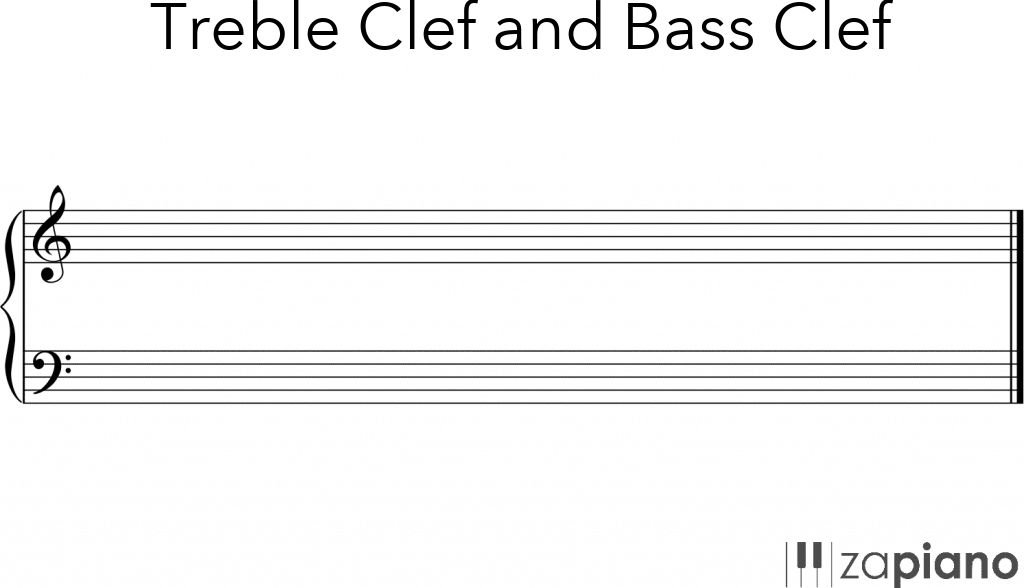
In general, the bass clef represents the notes you play with your left hand, while the treble clef shows the notes for your right hand. However, there are also passages in piano music where both hands move within the same clef, or where the hands switch clefs. But that’s only for the pros.
Reading both clefs at the same time is one of the first challenges when learning the piano, but with practice and experience, it becomes second nature.
Keep in mind: there are different levels of skill when it comes to reading music. I often hear people say, “I can already read music." But to put it metaphorically, most students can at best recite the alphabet.
Treble clef: what does reading music mean?
Reading music means:
- being able to identify and name notes by how they look on the page
- being able to play notes from the page without thinking
- being able to play notes from the page with the correct fingering
- being able to recognize notes written in several voices and name the harmony
- being able to read and play notes written in several voices
- then points 1–5 again, this time in the bass clef
- finally, being able to read both clefs together
Of course, this process can vary: you can also start reading music with both clefs right from the beginning, but then very slowly. It’s a bit like when we first learned to read.
At some point, “reading music" leads to “sight-reading": no matter what is put in front of you, you can play it straight from the page. That is the highest level of reading music.
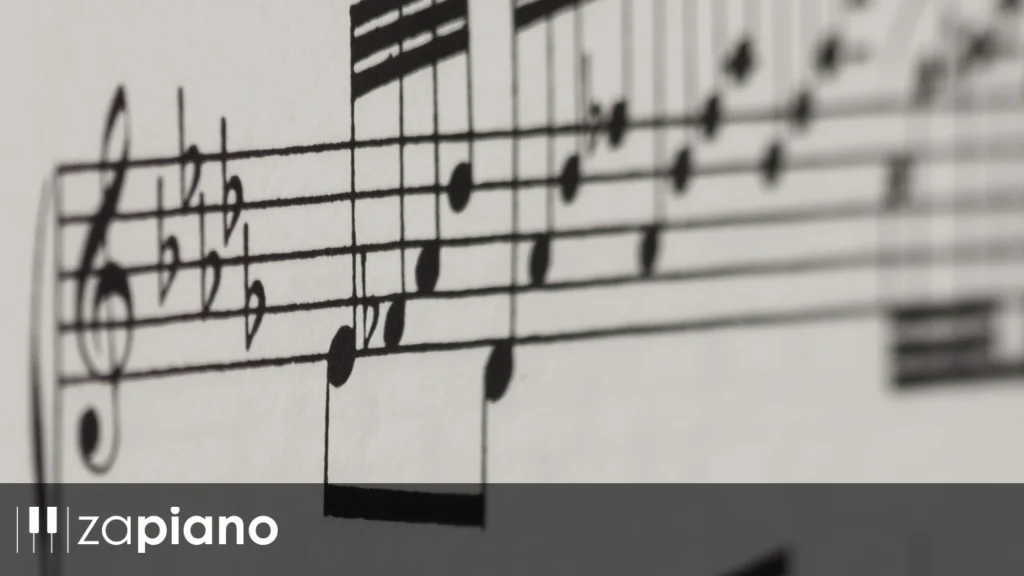
A special case: reading lead sheets
The treble clef is also always used for reading lead sheets. These are often vocal melodies written down in their simplest form. However, they are meant to be varied considerably according to taste and stylistic preference and really only serve as a basic guide. Just think of the singing of Billie Holiday or Ella Fitzgerald: they never sang note for note, but put their own personal stamp on every song.
Of course, the melodies can also be played on any other melody instrument. Ideally, musicians should always take their cue from the original, the way the singer sang it.