

Are you a beginner and not sure which piano keyboard is right for you and what the differences are? Here you’ll find all the information about black keys and white keys, so you can choose the right piano keyboard for you. The piano keyboard is one of the most important quality features of an acoustic piano or a digital piano, and depending on the price range, you’ll notice big differences. Knowing your way around the keyboard is also essential when you’re learning to play the piano and to read music. In this article, you’ll find lots of useful information about how a piano keyboard is built and what to look out for.
Feeling and Experiencing the Piano Keyboard
Many well-known pianists, composers and piano virtuosos know the feeling of being at home on their own keyboard. But what actually makes the ideal piano keyboard? Piano keyboards differ in a number of ways, and beginners have different requirements than experienced players. A professional can tell from the very first keystroke whether they’re happy with a keyboard or not. That’s why we’ve put together some useful tips on the piano keyboard for you – whether you’re a beginner or an advanced pianist.
What a Piano Keyboard Is Made Of
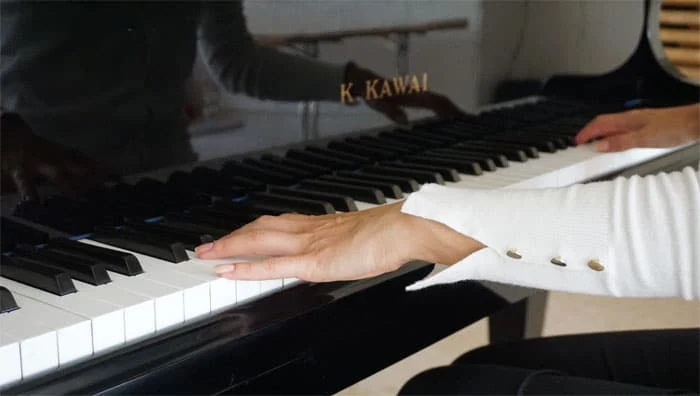
A standard piano keyboard has 88 keys: 52 white keys and 36 black keys. For a long time, piano makers covered the white keys with ivory from elephant tusks – something that’s hard to imagine today.
Fortunately, the ivory trade – and with it the use of ivory, not only for piano keys – is now banned to protect endangered species.
Depending on the price range, today’s keyboards are made of different materials. The demands on the material are high: the keys must not warp, they should be easy to clean, and they should be resistant to hand perspiration. The materials currently used for piano keys are:
- Wood
Mainly fine-grained wood is used. Fine-grained means that the wood grew very slowly, which makes it very stable: it moves less and doesn’t warp as quickly. Fine-grained spruce is a very popular wood for piano keys. - Plastics
Plastics are used either as a key covering or for the entire key. This includes colored acrylic glass, which looks very similar to ivory.
Manufacturers take different approaches here. Roland, for example, has long relied on plastic keys for its digital pianos and uses wood only in combination with plastic (hybrid keys) in some of its higher-end models. Kawai and Yamaha, on the other hand, use wood for the keys of many of their instruments.
The Weighting of the Piano Keyboard
When it comes to the keyboard, a grand piano is not only built completely differently from an upright piano – the weighting of the keys is different, too. Many manufacturers fit their grand piano models with heavily weighted keyboards. A keyboard like that is not suitable for piano beginners at all. The strength in your fingers has to develop first – there’s no way around it. It’s best to start out on an upright piano or a digital piano with a moderately weighted keyboard.
A stage piano with a weighted keyboard and hammer action can also be a good choice for beginners. It offers a piano-like feel and is usually easier to transport than an acoustic piano.
Only much later – once you’ve developed a solid playing technique – does it make sense to switch to a grand piano. The keyboard of a grand piano allows for much more nuanced playing, provided you have the necessary technique.

The Keys of an Electronic Keyboard
The main difference between an acoustic or digital piano and an electronic keyboard lies in the keys. On most keyboards, the keys are smaller or shorter, and many models have unweighted keys that are merely touch-sensitive. Touch-sensitive means that the harder you press a key, the louder the note sounds. However, the keys of a keyboard like that have no natural resistance, so most models are very limited when it comes to making beautiful piano music. If you’re thinking about buying a keyboard, make sure it has a piano-style keyboard with weighted hammer action.
The Basics of a Piano Keyboard with Weighted Keys
When you play the piano, you have to press a key with enough force for the hammer to strike the strings inside the piano. As soon as the hammer strikes the string, the key sounds its note. Once you’ve played a piano keyboard with weighted keys and then one without, you’ll know the difference. It can even be confusing when you have to switch between two pianos – for example, if you have your own instrument at home and then play a different piano at your lessons. The same can happen at a performance where you have to play an unfamiliar piano. Switching between different pianos and their keyboards can affect your playing, because pressing the keys can feel very different from one instrument to the next.
The Advantages of a Piano Keyboard with Weighted Keys
Weighted keys allow you to practice more effectively. The right sitting position also helps you play comfortably at the piano – a height-adjustable piano bench lets you set exactly the right height for you.
A keyboard with weighted keys can even help you develop the right amount of strength and dexterity in your fingers – two factors that make you a better musician overall. A digital instrument with weighted keys has further advantages, too: it never needs tuning, and a keyboard can even be carried around. That makes it more versatile than an acoustic piano, if that’s important to you. You can also plug in headphones so you don’t disturb anyone, which may even let you practice late in the evening. Depending on your living situation, that could be a real advantage. A hybrid piano gives you both at once: a full hammer action and the option of practicing with headphones.
Understanding and Internalizing the Keyboard
Besides the physical side of playing, the piano keyboard also asks you to understand how it is organized. To play effectively, you need to know the notes on the keys by heart, so that you can concentrate on the music instead of searching for the right notes on the keyboard.
As soon as you play your first scales, the black keys come into play. The F major scale is a good example: it runs almost entirely over white keys and needs only one black key, the Bb. That’s why it’s one of the first scales you can really get your hands around on the keyboard.
Especially if you’re teaching yourself the piano, you should consolidate these basics early on – they’re the foundation for everything that follows.
Once you understand the basics and have the right keyboard, nothing stands in the way of learning the piano successfully. The rules behind how scales are built are part of harmony theory.
Deepen Your Knowledge from the Start
Above all, though, solid basic piano skills are what count, so that later on you can play on all kinds of keyboards. Drawing on his 35 years of experience as a piano teacher, Sven Haefliger has developed a special method: the Zapiano® Method. With its holistic piano courses, you learn from the ground up and gain a deep understanding of playing the piano. You don’t just press the keys of your keyboard – you learn in a simple and effective way, so you don’t forget what you’ve learned after a short time. If you’re curious, simply sign up below for a free trial lesson. Have fun!