

What does 4/4 time mean? Music is always underpinned by a pulse – the constant, stable element of practically all music. The pulse is divided into units, and these units are the bars (also called measures). 4/4 time simply means that you can count to 4 before the next unit (bar) begins.
You’ve surely wondered at some point what 4/4 time means. In this article, you’ll learn all about bars, the metronome, meter, pulse and tempo. These are all key terms that are important for properly understanding music and time.
Practically every piece of music has a steady pulse. I’m deliberately talking about the pulse and not the bar here – the two are often confused.

When you listen to a piece of music, you’ll usually be able to clap along easily. It’s simply this constant element, very much like our heartbeat. The piece can be slow or faster – that’s the tempo. More on that later.

In every piece, the pulse (this constant element) is divided into equal sections. These sections are the bars, and the number of beats in each bar is described by the time signature.

If you counted along purely by ear and by feel, you would probably sense instinctively how to count. If the section you clap along to has 4 units, we call it 4/4 time.
So every piece is divided into equal sections, and the number of times you can clap along within one section determines the time signature.

The question now: how do you hear and feel this? Of course, it takes a bit of practice.
Every piece of music also contains a harmonic framework. If we overlay it with the pulse, a pattern emerges: the chords (that is, the harmonies) change on the “1”. Of course, this is only a rough rule, but for catchy, Western-style music you can sum it up in this simplified way. This results in a harmonic emphasis on the “1”.
Within the bar itself, we also speak of strong and weak beats: the “1” is the strongest, the “3” is less strong, the “2” is weaker still, and the “4” is the weakest.

This sounds very theoretical. In practice, it means that you have harmonic freedom around these strong beats. That’s more something for the jazz pianists among us. 🙂
You’re probably wondering now: what about the melody? Especially in jazz and pop, the melody leads a life of its own. As a beginner, you can’t “rely” on it when you’re trying to figure out the time signature by ear.
95% of all the songs we hear are in 4/4 time. Here I’d like to briefly explain the most important terms around time and bars:
1. Bar Lines and Bars:
- A piece of music is usually divided into sections of equal length, called bars (or measures).
- A bar is separated from the next bar by bar lines. Each bar has a certain number of beats, which is determined by the time signature.
2. Time Signature:
- The time signature shows how many beats there are in a bar and which note value counts as one beat. For example, a 4/4 time signature means that there are four beats per bar and that each beat has the value of a quarter note.
- Some common time signatures are 4/4 (four-four time, also called common time), 3/4 (three-four time, as in a waltz) and 2/4 (two-four time).
3. Strong and Weak Beats
- Within a bar, some beats are accented more strongly than others. In 4/4 time, for example, the first beat is usually the strongest, and the third beat often has a certain emphasis too. These accents help musicians and listeners feel the rhythmic flow of a piece and find their way around in it.
4. Metronome:
- A metronome is a device that produces regular beats at a set tempo. It helps musicians play at a steady tempo. The tempo is given in beats per minute (BPM).
Even Time Signatures
Even time signatures are 2/4 and 4/4 – for us, these are the simple time signatures. Because we’ve grown up with Western music, they’re usually easier for most people than other time signatures. We simply have a “better feel” for them.
Uneven Time Signatures
The best-known uneven time signature is 3/4 time, which is often associated with the waltz in classical music. Then there’s 6/8 time, which is related to 3/4: a 6/8 bar also contains six eighth notes, but they are grouped as 3 + 3 (so 6/8 is usually felt in two), while 3/4 has three quarter-note beats.
In other cultures, 7/8 time is also common, although it sounds unfamiliar to Western ears. A 7/8 bar is made up of smaller groups – for example 4 + 3 eighth notes – and the accents are usually placed accordingly.
Odd Time Signatures in Jazz
The Dave Brubeck Quartet made 5/4 time popular with its classic “Take Five”, composed by the quartet’s saxophonist Paul Desmond.
When Should You Use a Metronome?
Many people have terrible memories of the metronome. Although it’s a very good tool, it’s often introduced far too early. If you’re still busy with notes, fingerings and sight-reading and are supposed to play everything in time on top of that, it’s simply a constant source of frustration – because it’s quite simply too much at once.
On Zapiano®, I take a completely different approach:
At the beginning, it’s important that you learn to feel the pulse in your body – that you internalize a feeling for rhythm and movement.
Only when you think “now it’s easy” do we bring in the metronome in Piano Starter 1. Because once something already feels easy, it’s important to work on precision. Everything you play precisely on the piano will automatically sound good – provided, of course, that the harmonies and melodies are right.
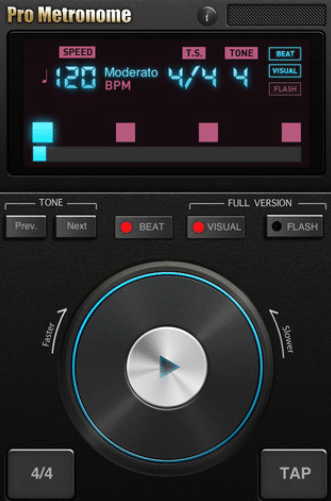
I also recommend no longer using a mechanical metronome. It becomes inaccurate over time, especially if it has ever been dropped – and that happens quickly. Use the “Pro Metronome” app as your metronome instead. It’s brilliant and leaves nothing to be desired.
Of course, writing all of this down in text form may also confuse you a little. Music is best understood through active listening. In the piano courses on Zapiano®, I don’t explain things too theoretically – instead, you grasp, understand and experience making music, and playing the piano in particular, on a deep level. So that in the end, you can really make music that touches you and others.