

If you are searching for “piano chord theory”, you probably want to gain an in-depth understanding of how music and harmony are built. That makes perfect sense. After all, a deep understanding of how music works gives you a solid foundation on which you can build a confident command of the piano.
For many people, playing the piano is also a lifelong dream they were never able to fulfill. The thought of finally being able to play the piano stirs something deep in many people’s hearts. Besides playing the piano, very few hobbies manage to add so much value to your life on so many different levels.

Playing the piano makes you happy
First, there is the sense of achievement. You learn something and soon have an audible result. It makes you really proud to have learned something completely new later in life.
Playing the piano is relaxing and does your heart good. When you make music, you can switch off the endless merry-go-round of thoughts and be fully in the moment with your music. That makes you happy and helps with all the worries and troubles that everyday life brings.
And last but not least, playing the piano also keeps your brain fit – especially when you take an in-depth look at piano chord theory. When you teach yourself piano, there is a lot to learn and understand.
So if you want to develop a deep understanding of the piano, here are a few recommendations for you:
Piano Chord Theory and Its Benefits
With piano chord theory, you can learn to understand what the white and black piano keys are all about. There are many different sounds and patterns. If you really grasp these relationships and truly understand how music is made, you can of course learn to play any song. Let’s look at the basics here.
1. Piano Chord Theory: Learn the Intervals
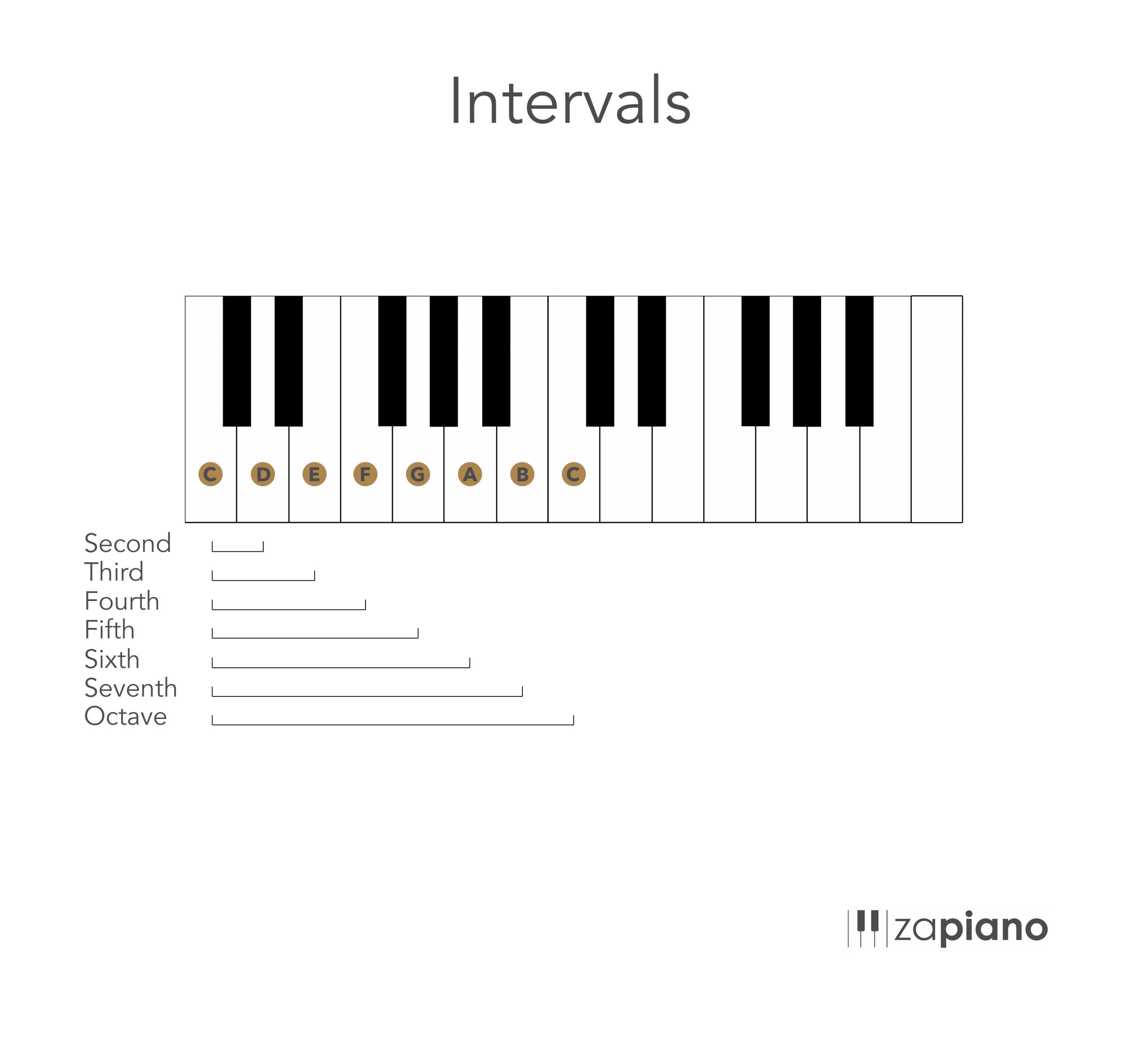
To better understand intervals, it’s worth looking at scales first. Here, for example, are the intervals of the C major scale:
- Unison: from C to C
- Second: from C to D
- Third: from C to E
- Fourth: from C to F
- Fifth: from C to G
- Sixth: from C to A
- Seventh: from C to B
- Octave: from C to the next C
If you want to understand the distances between these intervals even more precisely, the chromatic scale will help you, because it shows all the semitone steps within an octave.
Conversely, you can also leave out intervals: if you remove the fourth (F) and the seventh (B) from this series, you are left with C, D, E, G and A – the five notes of the pentatonic scale. Because this removes both semitone steps of the scale, this selection sounds especially open – which is why it is the usual starting point for improvising.
Look at the intervals until you have internalized them. Once you have understood all of this, you can move on to the next step.
2. Learning Chords
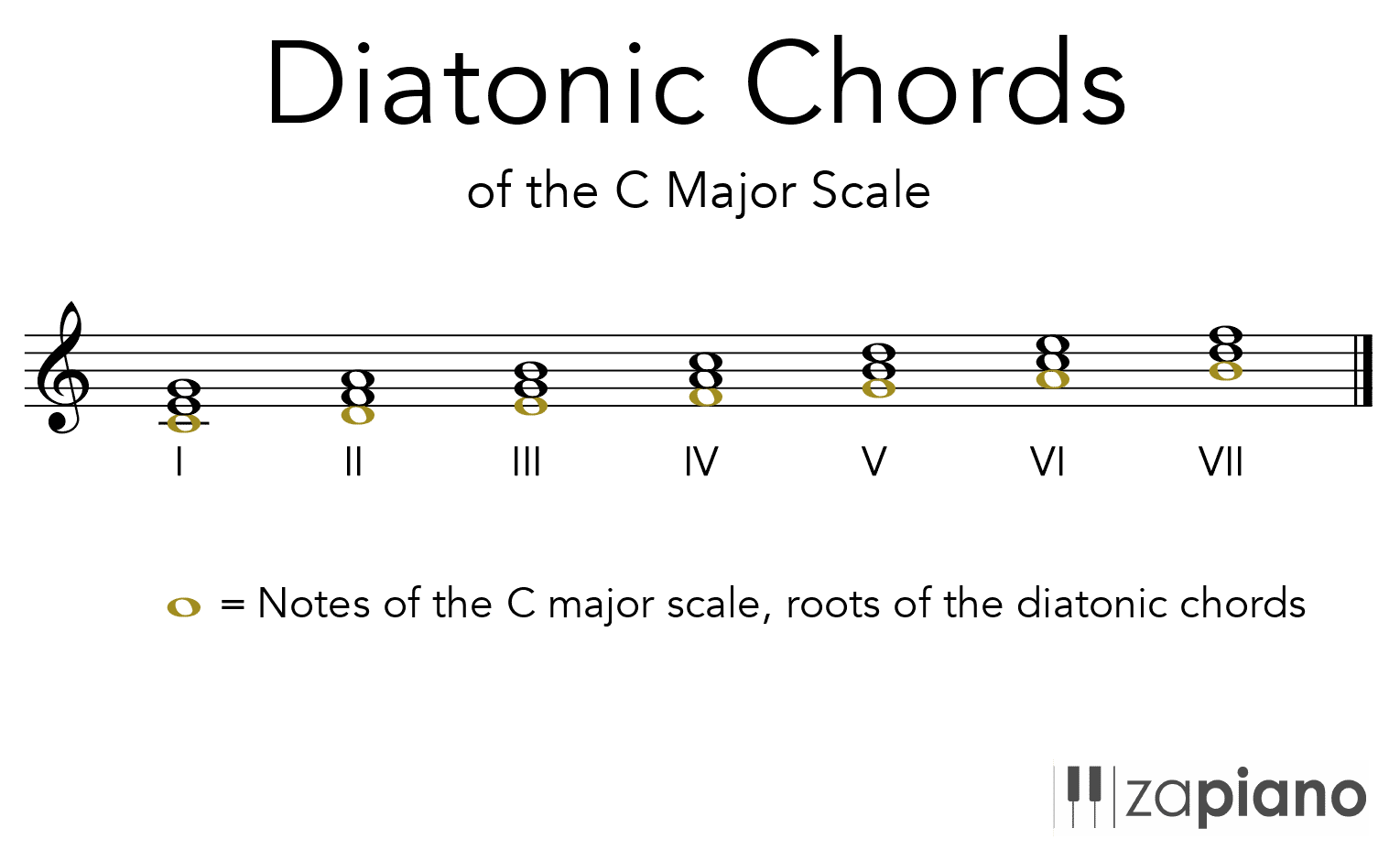
When learning chords, it is important to understand the so-called diatonic chords – the chords built on each degree of a scale. This is standard chord theory. Here, too, we’ll stay in a major context for now so that it doesn’t get too complicated.
- 1st degree: C major
- 2nd degree: D minor
- 3rd degree: E minor
- 4th degree: F major
- 5th degree: G major
- 6th degree: A minor
- 7th degree: B diminished
Take a look at these chords (you can find more details here) and feel free to try them out on the piano keyboard 🙂
3. Learn the Inversions in Piano Chord Theory
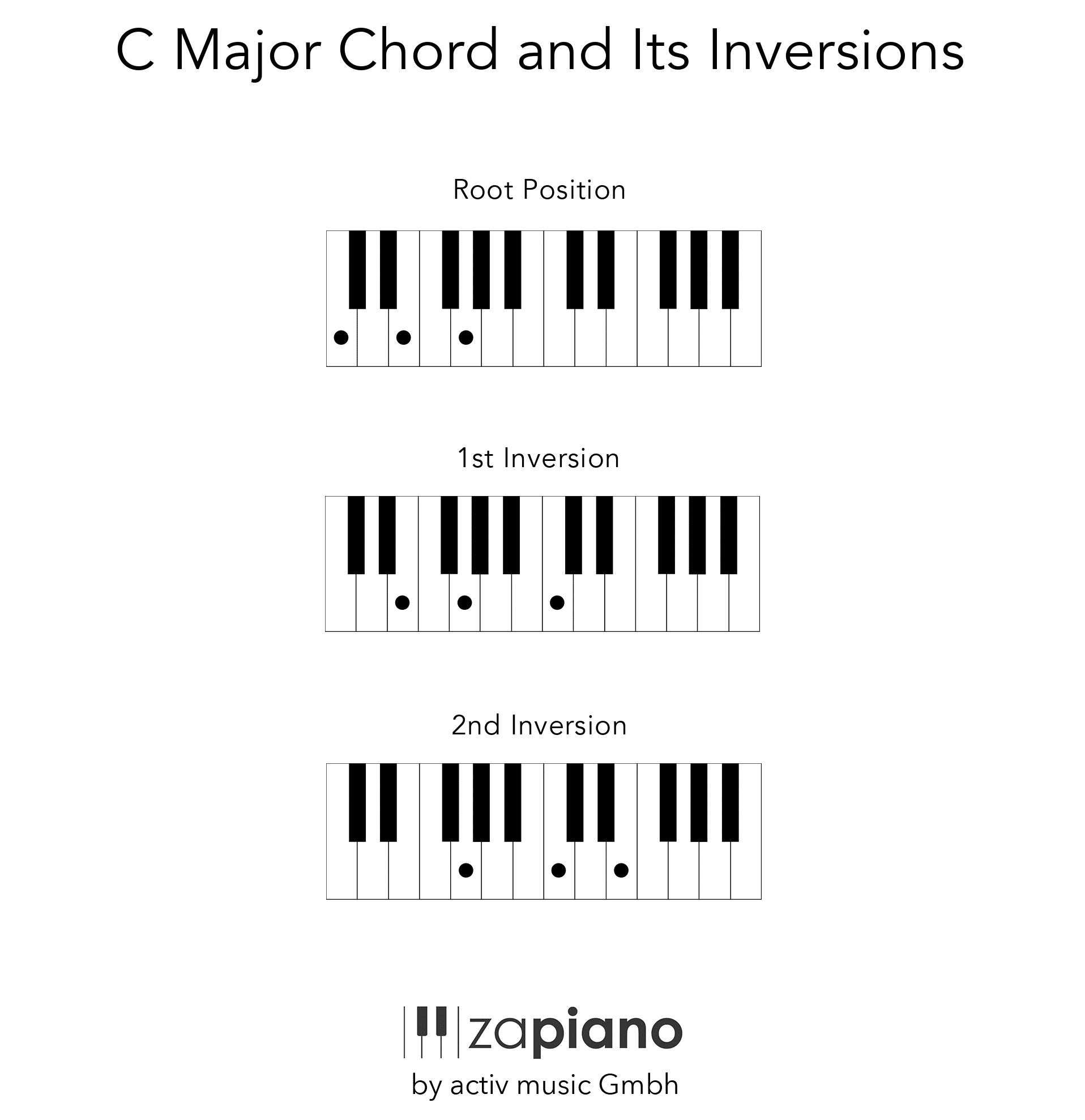
Things get exciting when you consider that each of the chords above also has two inversions. Two, because each of these chords is a triad made up of three notes. Here, for example, are the inversions of C major:
- Root position: C, E, G
- 1st inversion: E, G, C
- 2nd inversion: G, C, E
Now you are probably wondering why you need inversions at all. After all, they are always the same notes – just in a different order.
However, when playing the piano, you often choose the closest path from one chord to the next. Just try it out for yourself. Inversions also make it very easy to create new sound variations. You can get really creative with them. It also has to do with voice leading. But that’s probably getting too specialized 🙂
Simply Try Zapiano®
If you’d like to know more about how piano chord theory works, take a no-obligation look at our interactive course Piano Starter 1. In it, we explain all the musical relationships from the ground up. Below, you can sign up for a free trial lesson. If you want to understand it even more deeply, our article on harmony theory takes a closer look at the musical relationships.
You will surely notice right away that learning the piano with Zapiano® is somehow different. That’s because we learn to play the piano holistically according to the Zapiano® Method. This means that all of our senses are engaged: understanding, hearing, seeing, touching and feeling are given equal weight. As a result, your first successes come very quickly, and you can learn the piano effectively and with a lot of joy from home.
All you need is a piano and a tablet. Try our free trial lesson with no obligation. We hope you enjoy it.
If you have any questions, you can reach us via the contact form.