

You’ve probably heard of the pentatonic scale before in connection with improvising, the blues, or Far Eastern music. In this blog, you’ll find out what it is and where the pentatonic scale is used.
So: What is the pentatonic scale? Pentatonic refers to a five-note scale. The word comes from the Greek “penta” (five) and “tonikos” (tonal). The pentatonic scale is found in many cultures around the world and is considered one of the oldest musical scales.
The pentatonic scale is especially popular in the folk music of various cultures as well as in blues and rock music. But what do you need the pentatonic scale for? And how can you best use it? Just read on – we have answers to all your questions on this topic.

The different types of pentatonic scales
First of all, it’s important to know that there are two main types of pentatonic scale:
- Major pentatonic scale: This scale can be produced by playing the black keys of a piano from F# to F#. In C major, the scale would include the notes C, D, E, G, and A.
- Minor pentatonic scale: often used in blues music. It can be produced by playing the black keys of a piano from Eb to Eb. In A minor (the relative minor of C major), the scale would include the notes A, C, D, E, and G.
While these are the two main types of pentatonic scales, in theory you can start a pentatonic scale on any note and use different combinations of intervals. This means there are many different “pentatonic” scales, depending on how you choose the five notes. However, the major and minor pentatonic scales described above are the best known and the most commonly used.
If you consider every possible starting note on a piano (or any other chromatic instrument), however, there are 12 major pentatonic scales and 12 minor pentatonic scales – one for each note. Regardless of the starting note, these scales keep their characteristic interval structures.
What is the difference between a diatonic scale and the pentatonic scale?
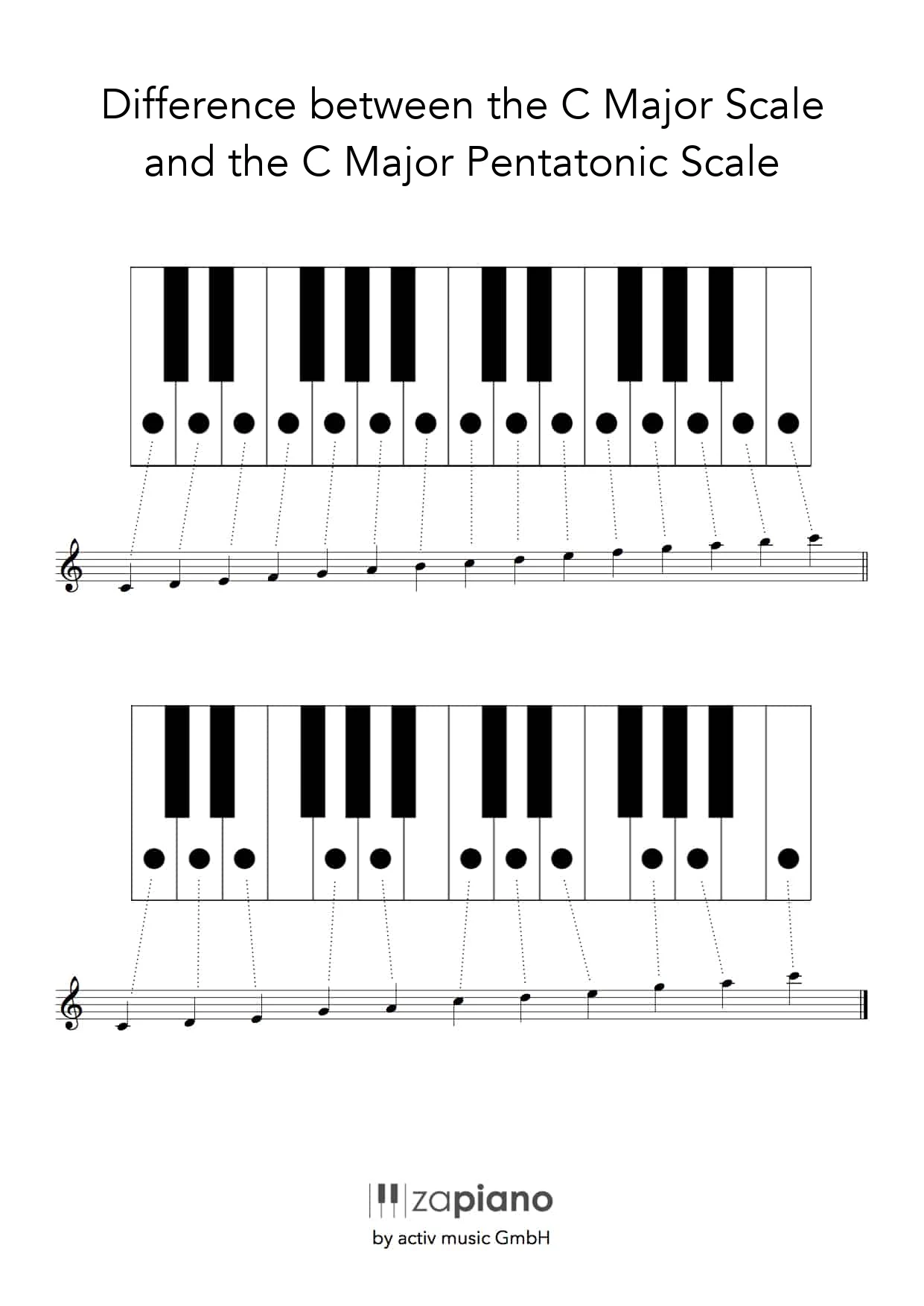
The difference is actually quite simple: the pentatonic scale is just missing 2 notes that occur in the diatonic scale. What’s interesting is that it’s exactly these 2 notes that create the tension that is sometimes desired in a diatonic context.
In a C major scale, the notes would be:
C, D, E, F, G, A, B, C
The major pentatonic scale contains the notes:
C, D, E, G, A, C
The notes F and B are left out. Depending on how intervals are built and chords are formed, it’s precisely these 2 notes that create tension. Take a look – the graphic shows the difference once more:
Here’s an overview of the key points:
Diatonic scale
- “Diatonic” refers to a seven-note scale.
- A diatonic scale contains seven different notes (before reaching the octave).
- Using C major as an example: C, D, E, F, G, A, B (and then C again for the next octave).
- Using A minor (natural minor), the relative minor scale of C major, as an example: A, B, C, D, E, F, G (and then A again for the next octave).
Pentatonic scale
- “Pentatonic” refers to a five-note scale.
- A pentatonic scale contains only five different notes.
- Pentatonic scales are often easier to play and to hear, since in many cases they contain no semitones.
- The major pentatonic scale of C major would be: C, D, E, G, A.
- The minor pentatonic scale of A minor would be: A, C, D, E, G. It is considered the most important pentatonic scale and is especially popular with guitarists, because it is technically easy to play.
In summary
- A diatonic scale contains seven notes and spans the entire octave, including two semitone steps.
- A pentatonic scale contains only five notes and leaves out some of the diatonic notes, which often results in a more “open” sound.
- In the context of C major and A minor: while the diatonic scales include all the notes from C to B (for C major) or from A to G (for A minor), the pentatonic scales focus on a selection of five of these notes.
- Pentatonic scales are used in all styles of music. Because they have no semitone steps, they contain less tension than diatonic scales and therefore sound pleasant to every listener. It’s precisely this lack of semitone steps that gives them their characteristic, somewhat monotonous sound without any rough edges.
- It’s often called the most popular scale. Every musician who gets into improvisation usually starts with the minor pentatonic scale – and in one particular key: the A minor pentatonic scale, which uses only white keys on the piano. On the guitar, it’s easy to play at the fifth fret, even for beginners.

The difference between the pentatonic scale and the blues scale
The minor pentatonic scale and the blues scale are both very popular in blues and rock music. However, there is one crucial difference in the notes they contain.
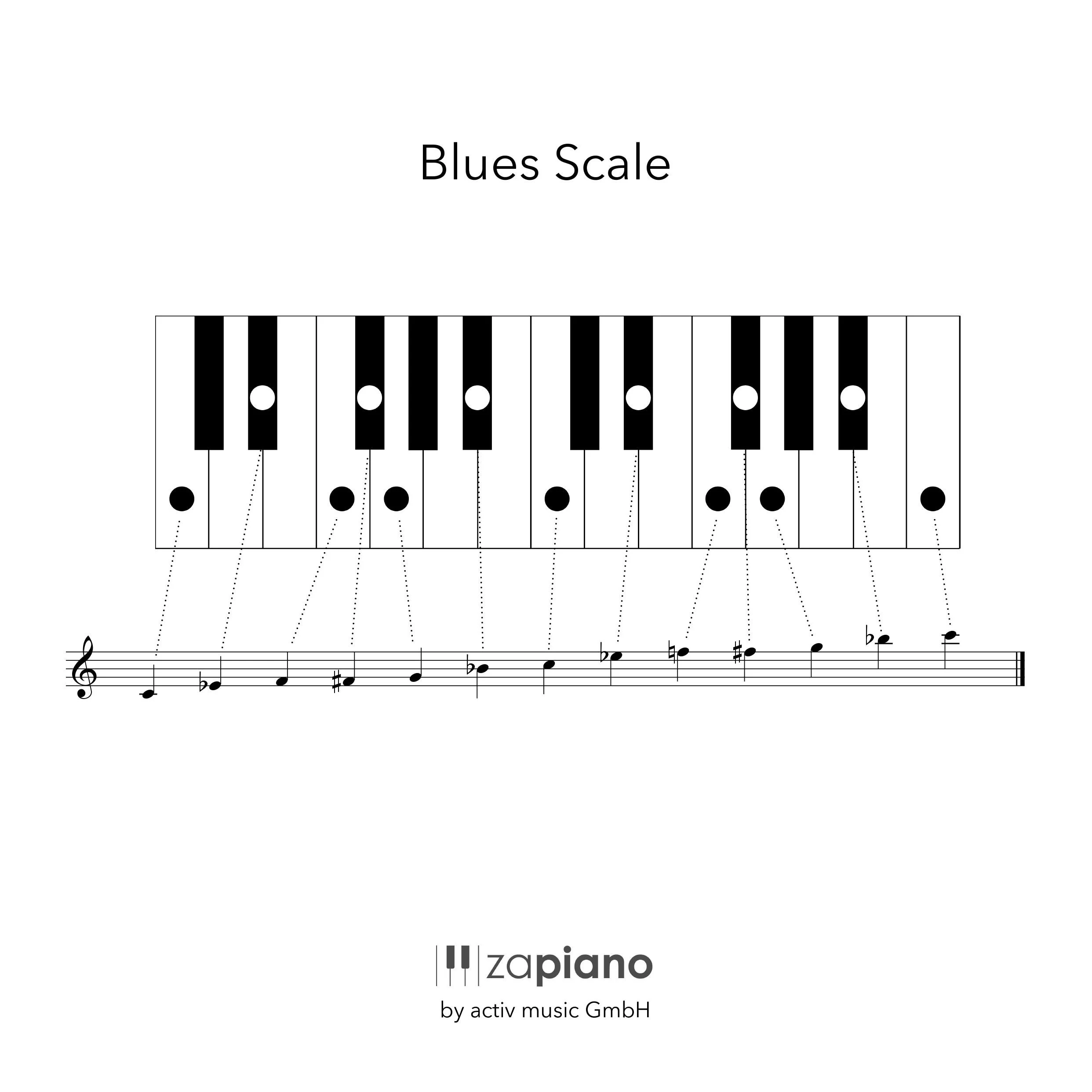
As described above, the pentatonic scale contains 5 notes. The blues scale adds one more note:
- The blues scale builds on the minor pentatonic scale and adds an extra “blue” note, often simply called the “blue note.” This note is a tritone away from the root.
- For the A blues scale, the notes would be: A, C, D, D# (or Eb), E, G. Here, D# is the “blue note.”
So the main difference between the two scales is this additional “blue note” in the blues scale. This note gives the scale a characteristic “dirty” or “bluesy” sound that is typical of the blues. It’s this special note that creates the characteristic plaintive or “bittersweet” tone of the blues.
Using the blue note takes a lot of practice and a good ear. As a musician, you need to know exactly where this note sounds “blue” – and where it simply sounds wrong.
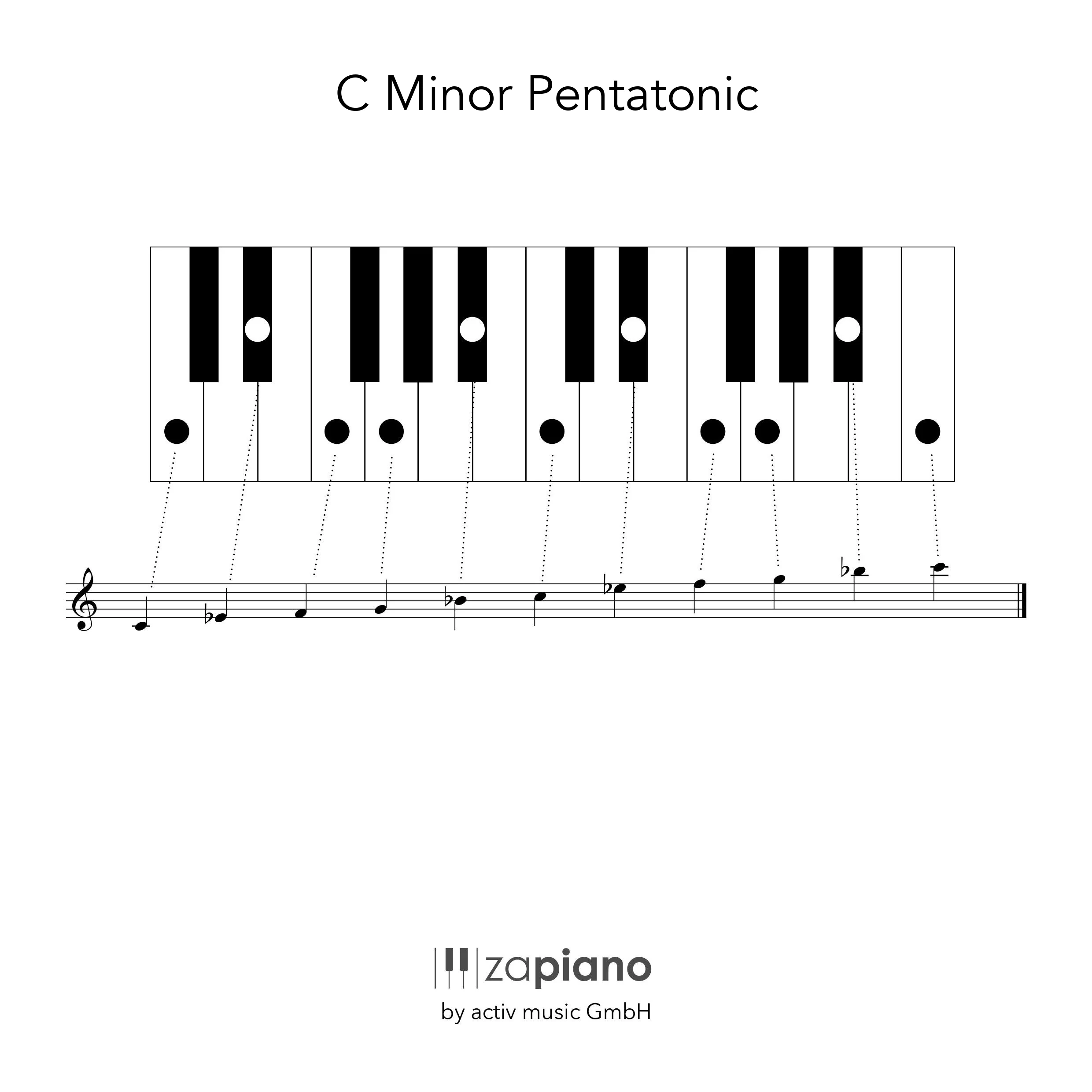
Take a look – here you can see the difference between the C minor pentatonic scale and the blues scale based on it:
The pentatonic scale in Far Eastern music
If you’ve ever walked into a traditional Chinese restaurant, you’ve probably noticed the rather uniform music playing in the background.
The pentatonic scale plays a central role in traditional Chinese music. Many traditional Chinese instruments are tuned to this scale, and the pentatonic structure runs through much of Chinese folk music and the classical repertoire.
The Chinese pentatonic scale often differs somewhat from Western pentatonic scales, but the basic concept of using a scale of five main notes remains the same.
The traditional Chinese pentatonic scale usually consists of the notes that, when transferred to a Western piano, correspond to the black keys: F#, G#, A#, C#, and D#. These notes correspond to the five main tones in many parts of traditional Chinese music, although there can be various regional and stylistic variations.
It’s also important to note that while the pentatonic scale dominates Chinese music, this doesn’t mean that only these five notes are used. There are many examples of traditional Chinese music that go beyond the limits of the pentatonic scale, especially in certain regional styles or in modern and contemporary Chinese music.

The pentatonic scale in jazz
In modal jazz, as in popular music in general, musicians often experiment with pentatonic scales.
If, for example, the underlying chord is a Dm chord, then in theory you would use the D minor pentatonic scale. You could also enrich it with the blue note, but many jazz musicians quickly find this boring, because there is hardly any interplay between tension and release. Jazz thrives on notes that are “out.” That’s what makes this music really interesting. The jazz musician’s goal is to find the ideal balance between notes that are “out” and notes that sound pleasant (consonant).
Let’s say you’re playing over a Dm7 chord (D minor 7) in a jazz tune. The standard minor pentatonic scale used over this chord consists of the notes D, F, G, A, and C.
In terms of functional harmony, these notes are:
D – root
F – minor third
G – perfect fourth
A – perfect fifth
C – minor seventh
In this case, the blue note would be Ab (G#), the diminished fifth.
Now there’s a trick that jazz musicians use: they simply play the minor pentatonic scale one interval higher. So it’s again a minor pentatonic scale with the same intervals, but in terms of functional harmony, it produces different notes.
Complicated? It only sounds that way. 🙂
To play this minor pentatonic scale a fifth higher, you transpose the notes D, F, G, A, and C up a fifth. A fifth above D is A. So if you play the minor pentatonic scale a fifth higher over the Dm7 chord, you get the notes A, C, D, E, and G.
In relation to the Dm7 chord, this pentatonic scale has the following intervals:
- A – perfect fifth above the root D
- C – minor seventh above the root D
- D – unison, i.e., the root itself
- E – major second or major ninth above the root D
- G – perfect fourth above the root D
In this example, we suddenly get a new note that wasn’t used in the original pentatonic scale: the ninth.
So when you improvise over a minor chord, you have the option of playing the minor pentatonic scale
- from the root of the chord, or
- a fifth above the root of the chord.
This instantly gives you a slightly different color.