

You’ve probably heard the term “chromatic" in connection with scales before. This blog post will help you get an overview of the topic of the “chromatic scale“.
What does “chromatic scale" mean? It’s a scale made up of all twelve semitones within an octave. Our Western music is built on 12 notes, while each key uses only its diatonic scale.
Unlike diatonic scales such as the major or minor scale, which consist of seven notes (plus the octave), the chromatic scale contains every possible note within an octave.
This means it can’t be assigned to any key, since any of the 12 notes can be the root. How keys are built is explained in harmony theory.
The Chromatic Scale in Notation
In notation or on a piano, this means playing every white and black key from a given starting point up to the point exactly one octave higher.
An example of an ascending chromatic scale starting on C would be:
C, C#/Db, D, D#/Eb, E, F, F#/Gb, G, G#/Ab, A, A#/Bb, B, C (one octave higher)
Here, the notes C#, D#, F#, G# and A# are the black keys on a piano, and the other notes are the white keys.
Take a look: in this graphic you can see once again very clearly what it looks like on the piano keyboard:
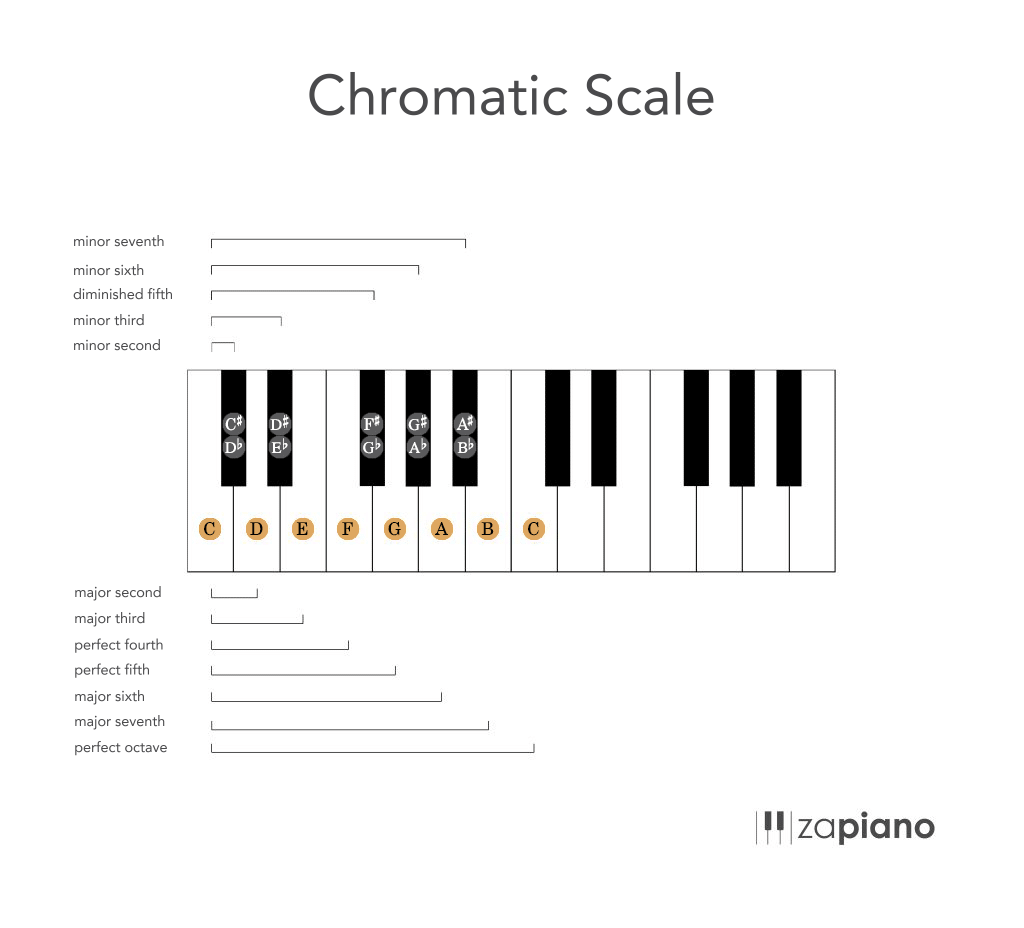
The chromatic scale has no specific key or “center" in the traditional sense, since it includes every possible note in the octave. All intervals are contained in it. The scale is often used to create a floating, undefined or tension-filled character in music.
Of course, it’s also used again and again in jazz for improvisation. You don’t necessarily talk about the scale as such, but you use it for tension-filled passages when improvising. That way you can give your playing more tension and release.