

There is a vast repertoire of folk, pop and classical music. If you take a closer look at the individual pieces, you will notice that the same harmonies are often played. But how can harmonies actually be organized into a system? That is exactly what harmony theory is about. Find out what a chord actually is. And what, then, are the basic chords?
Basic Chords Based on the Diatonic Chords
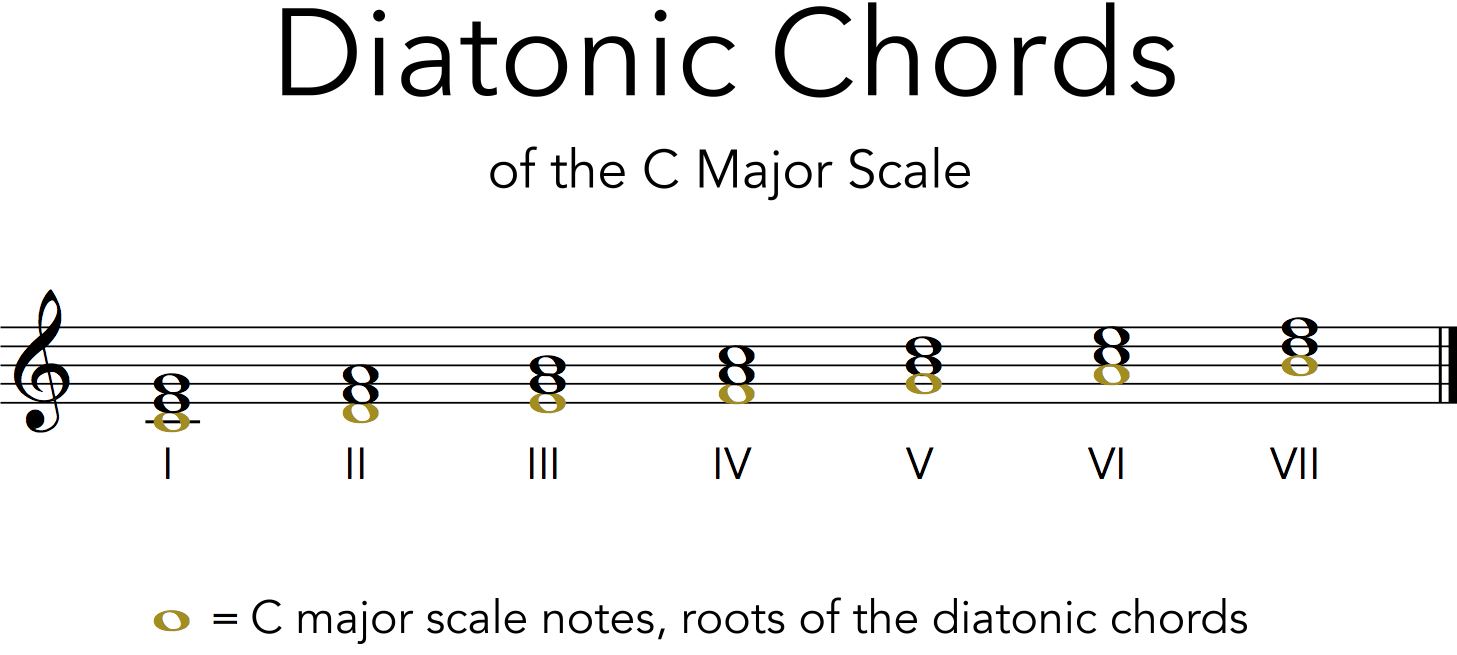
If we look at the C major scale, we have the notes C, D, E, F, G, A, B and C. If we take each of these notes as a root and build a triad on it, the results are called diatonic triads. Diatonic means in this case that the new chords are formed from the notes of the C major scale. From the seven notes of the C major scale, we therefore get seven different diatonic chords, namely: C, Dm, Em, F, G, Am, B°.
These diatonic chords are then numbered with Roman numerals according to their scale degree. This gives us:
- Degree I: C major
- Degree II: D minor
- Degree III: E minor
- Degree IV: F major
- Degree V: G major
- Degree VI: A minor
- Degree VII: B diminished
The Most Common Diatonic Chords
Now that we know what diatonic chords are, it is also important to know that certain diatonic chords occur particularly often in music of all genres. These chords are often referred to as basic chords. They are the chords on degrees I, VI, IV and V, i.e. C major, A minor, F major and G major. You will find them in a great many pieces of music. If a piece is transposed into another key, these four chords move along with it. In the E major scale, they are E, C#m, A and B.
Four-Chord Songs: Having Fun with Basic Chords
A group called The Axis of Awesome shows just how many pieces of music are actually based on the basic chords. They are a band of Australian musicians who have made some pretty cool YouTube videos with comedy elements. In one of them, they sing a medley made up of lots of well-known pop songs. Take a look!
Simply Learn the Basic Piano Chords
As you can see, if you simply learn the basic chords, you can already get quite creative at the piano. And the good news is: at Zapiano®, there are also piano pieces for beginners that are based on these basic chords. This way, you can start playing music at a very early stage, even as a beginner.
Basic Chords and Accompaniment Patterns
But we don’t just play the basic chords on the piano in root position. We also learn the chord inversions and many different accompaniment patterns and accompaniment techniques. We already start with this in our successful course Piano Starter 1, which we recommend to all piano beginners. Advanced piano students also benefit from the Piano Starter 1 course and regularly tell us that it helped them close quite a few gaps in their knowledge. You will also find valuable tips and tricks there. Feel free to take a look at a free trial lesson 🙂
Learning Basic Chords with the Zapiano® Method
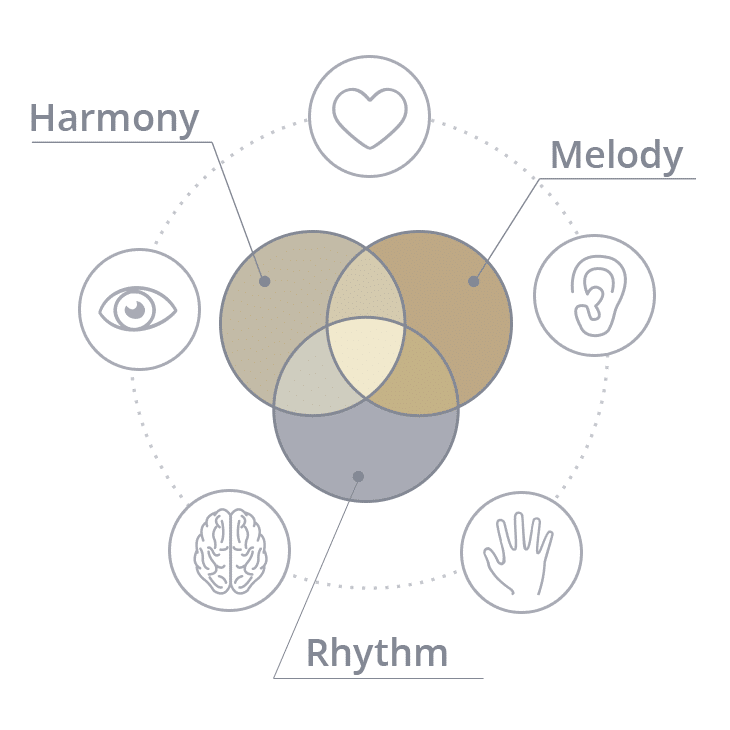
At Zapiano®, we learn the basic chords according to the Zapiano® Method. This means that we involve all of our senses in learning. As a result, the learning content, and with it your command of the basic chords, sticks much better and lasts longer. In the course, we learn the songs from sheet music and play exactly what we have learned. At the same time, we also learn to shape the pieces freely and to improvise on them. This way, you can give every piece your own personal touch and get really creative.
If any questions come up, the Zapiano® team is always there for you. You can ask your question below each lesson or use the contact form. If you are unsure about something, you also have the option of sending us a video of your piano playing once a month. One of our Zapiano® coaches will then watch it and give you feedback. As you can see, we at Zapiano® place great value on interaction with our students. Feel free to try Zapiano® in a free trial lesson below 🙂