

Not all scales are the same – in fact, there are countless of them. At first, this may seem complicated. But don’t worry, I’ll clear things up. So:
What is a scale? A scale is an arrangement of different notes that stand in specific intervals to one another. In this context, the major scale, with its major and perfect intervals, forms the reference structure.
You probably have questions such as:
- “What is the difference between a major and a minor scale?”
- “Is a C major scale on the piano the same as a C major scale on the guitar?”
- “How many of them are there, anyway?”
- And the key question: If you want to play the piano, do you have to know and understand all the scales?
Scales and their chords form the cornerstone of our Western music. All pop songs, jazz standards and classical piano works are based on them. In this article, I’ll explain some interesting facts about the topic so that you can get a good overview.

1. 99% of All Adults Can Sing a Scale
At the beginning, I always ask my students whether they’d like to try singing a scale. It doesn’t matter which note you start on. Just give it a try. I can already tell you with 100% certainty that you’ll sing a major scale.
Interestingly, I have yet to meet anyone who sang any other scale. Why is that?
2. How the Major Scale Shapes Our Hearing
The peculiarity mentioned above has a very simple explanation:
We all grew up with the same Western music.
It doesn’t matter whether it’s
- popular hits,
- folk songs,
- pop songs,
- jazz standards
- or classical music.
All of these styles are based on the major scale, or rather on the diatonic system. Our ears are practically trained for it – unless you grew up in Turkey, India or Saudi Arabia. The folk music in these countries is different, and accordingly, the people who live there are used to hearing something else. These are just a few examples of countries with a different musical culture. You’ll find more in the Far East. Did you know that? I find it fascinating.
3. Which Time Signatures Are Common in Other Cultures?
Like the major scale, 4/4 time is part of our Western culture. Most people are also familiar with 6/8 time or 3/4 time. But what about Hungary, for example? There, 7/8 time is commonplace – and the tonal material is different, too. In India, on the other hand, people don’t just know the 12 semitones we use; there are also notes in between that can’t be placed within our system. Your sociocultural environment depends on where you grow up – and it shapes you musically, too, so you develop different listening habits. That’s why music from other cultures sounds so different to us: it doesn’t match what we’re used to. It’s really exciting. Just listen to a few examples and test it for yourself 🙂
4. The Major Scale Formula
Without thinking about it, everyone in our culture sings the major scale the same way: it consists of a sequence of different steps that always follows this pattern:
whole tone – whole tone – semitone – whole tone – whole tone – whole tone – semitone. Visually, it looks like this:
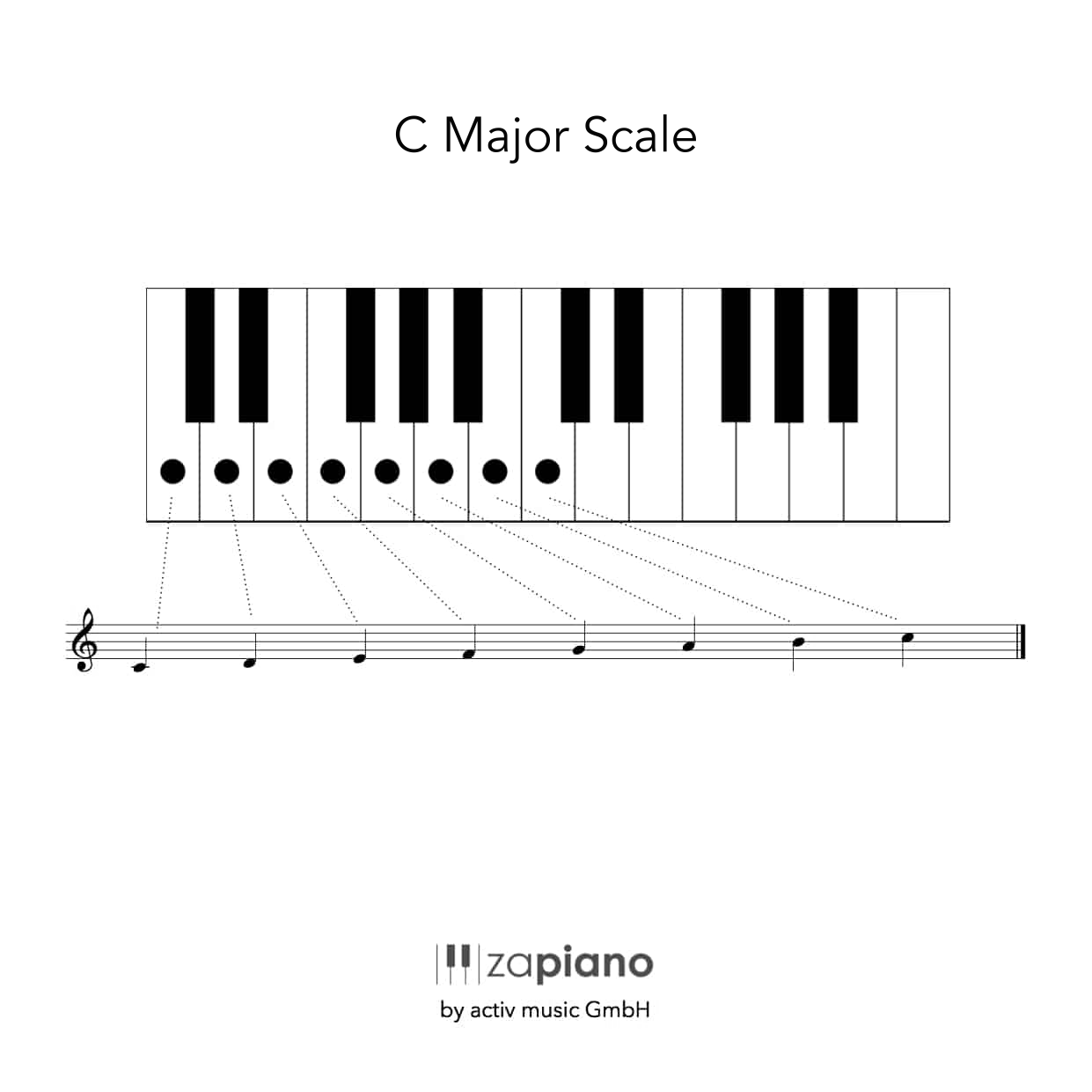
First of all, there are semitones and whole tones. So we have a semitone, also called a half step, between the third and fourth notes and between the seventh and eighth notes. That’s also where there’s no black key between the white keys. The eighth note is the root again, just an octave higher. Then the sequence repeats across the rest of the keyboard. It’s always the same. As a rule, all of this is first explained using the key of C major. That’s easiest for pianists in particular, because these notes are all on the white keys.
If you take the starting note, C, as your reference point and relate every other note to it, the distance between them is called an interval.
5. Are There Major Scales in Other Keys Too?
Yes, of course. Since we have a total of 12 notes available, any note can be the root. So there are 12 different keys and, accordingly, 12 different major scales. The formula mentioned above always stays the same, though. I’ve listed them all below.
Here you’ll find a detailed guide to each major scale and how to practice it correctly on the piano:
the C major scale on the piano
the G major scale on the piano
the D major scale on the piano
the A major scale on the piano
the E major scale on the piano
the B major scale on the piano
the F# major scale on the piano
the Db major scale on the piano
the Ab major scale on the piano
the Eb major scale on the piano
the Bb major scale on the piano
the F major scale on the piano
6. What About Sad Songs?
The natural minor scale is what we call the relative minor. With the C major scale, it works like this:
The major scale starts on the note C:
C – D – E – F – G – A – B – C
The relative minor scale is nothing other than a C major scale, just with a different starting note:
A – B – C – D – E – F – G – A
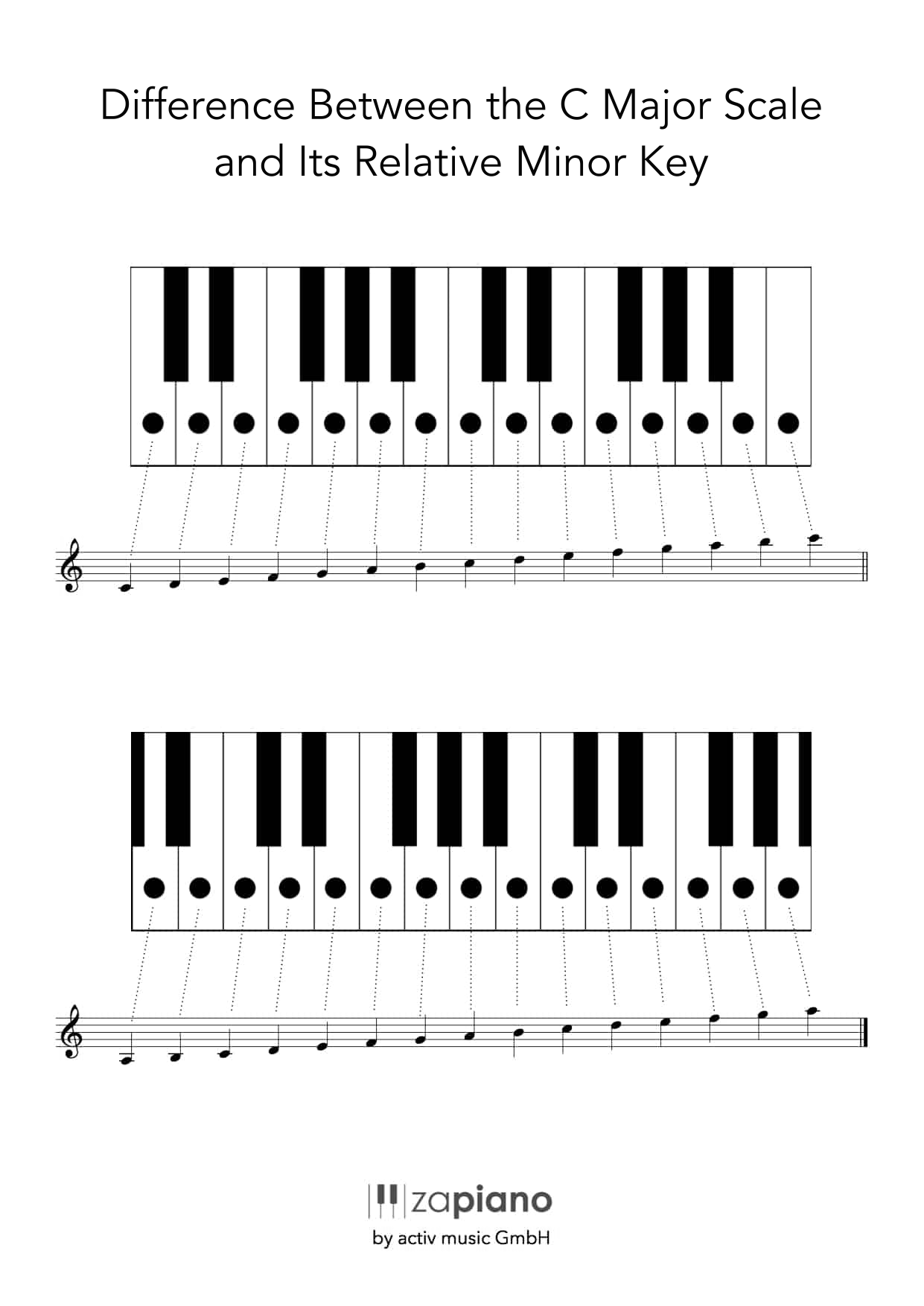
So we have the same notes again – all white keys on the piano – but in a different order. The result is A minor. Of course, any other note can also serve as the root. Then we’re talking about the so-called modes, also known as church modes. In music, there’s also the chromatic scale.
All pop music is built on this diatonic system. If you have any questions, you can reach me at any time through various channels – I offer my students many ways to interact with me. If all of this seems too complex at first, simply start with Piano Starter 1. There, we start slowly and from the very beginning.
7. List of All Major Scales and Their Relative Minor Scales
For the sake of completeness, here’s a list of which major and minor scales belong together:
- C major scale / relative minor scale: A minor
- Db major scale / Bb minor scale
- D major scale / B minor scale
- Eb major scale / C minor scale
- E major scale / C# minor scale
- F major scale / D minor scale
- F# major scale / D# minor scale
- G major scale / E minor scale
- Ab major scale / F minor scale
- A major scale / F# minor scale
- Bb major scale / G minor scale
- B major scale / G# minor scale
Here you’ll find a detailed guide to the minor scales and how to practice them correctly on the piano, including their fingerings:
the A minor scale on the piano
the D minor scale on the piano
the G minor scale on the piano
the C minor scale on the piano
the F minor scale on the piano
the Bb minor scale on the piano
the Eb minor scale on the piano
the G# minor scale on the piano
the C# minor scale on the piano
the F# minor scale on the piano
the B minor scale on the piano
the E minor scale on the piano
8. Pentatonic Scales
There are different types of scales, such as the pentatonic scale. You’ve probably heard of it before. “Penta” comes from Greek and means “five.” So a pentatonic scale is a type of scale that consists of only five notes. You may also have come across the term “five-note scale.” Here you can learn more about the pentatonic scale.
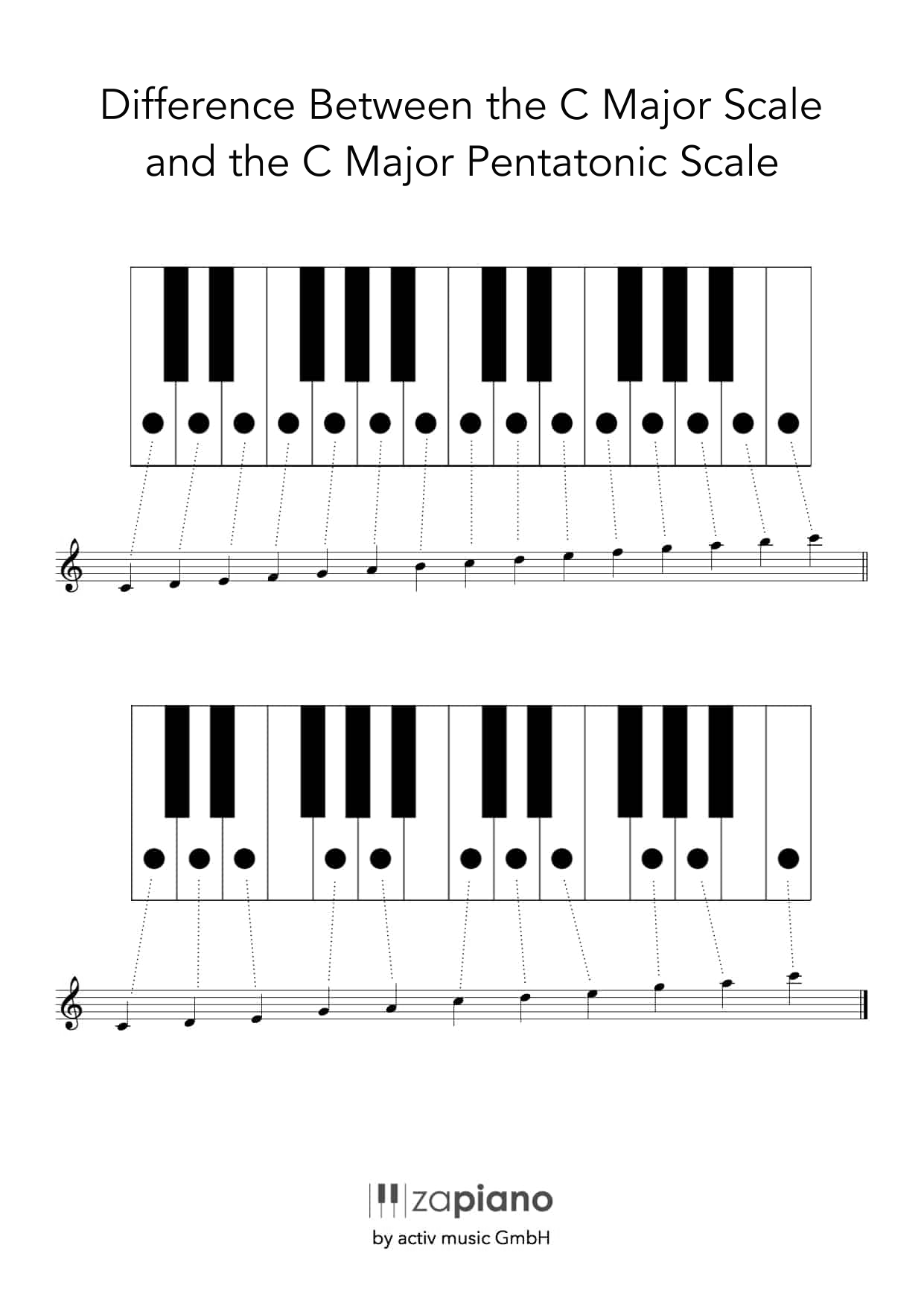
Difference Between the C Major Scale and the C Major Pentatonic Scale
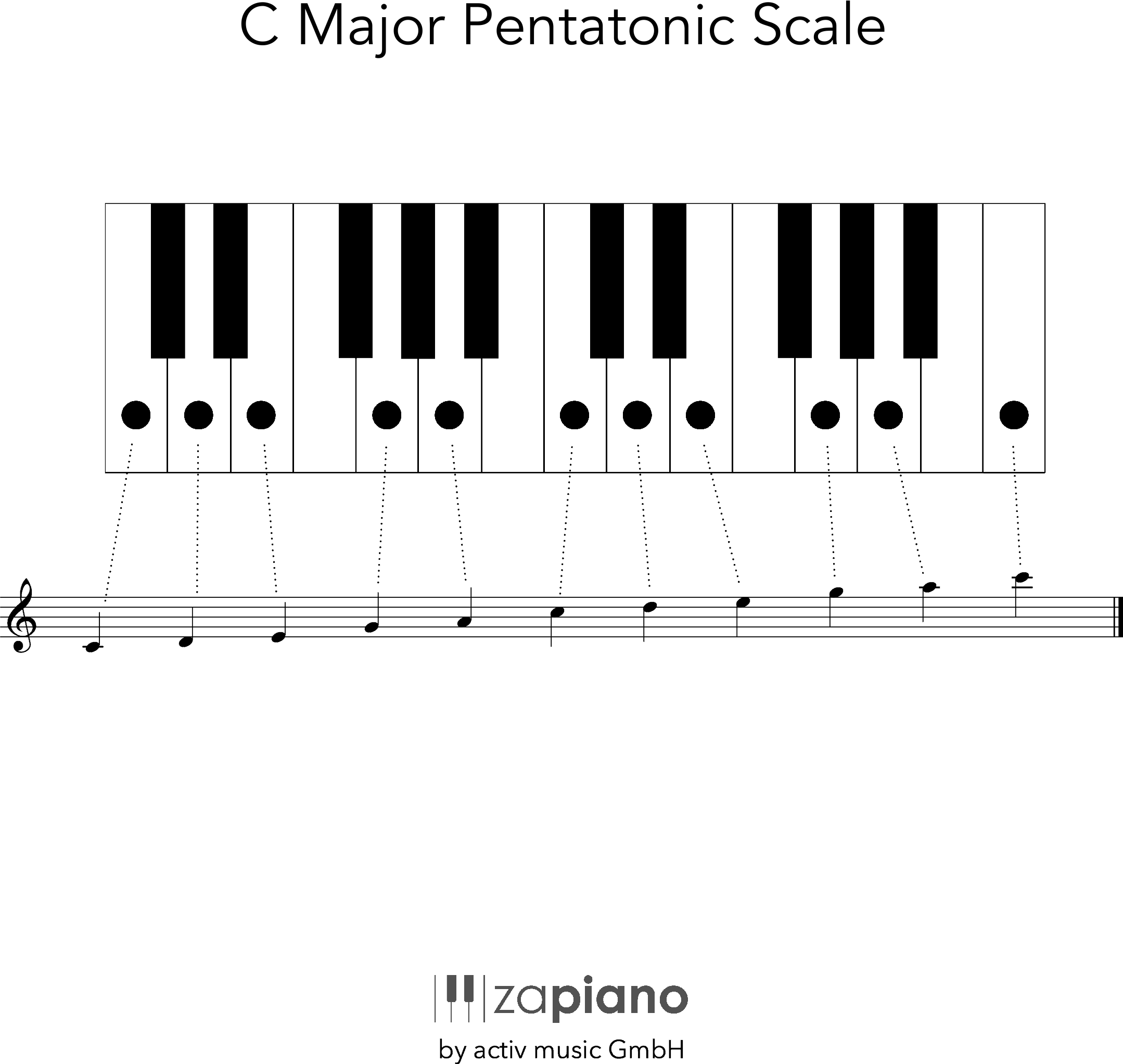
Take a look at this graphic: you’ll notice that, compared to the C major scale, two notes are missing. These are the fourth (F) and the major seventh (B). So the C major pentatonic scale consists of the notes C, D, E, G and A.
Improvising with Pentatonic Scales
Pentatonic scales are great for improvising, because there’s hardly any tension in the melody and all the notes sound pleasant in the harmonic context. That’s because there are no dissonant intervals such as minor seconds, tritones or major sevenths within the pentatonic scale. If you take a close look at the C major pentatonic scale, you’ll notice that, unlike the regular C major scale, it contains no semitone steps at all – only whole tones and minor thirds. In many well-known pop songs and children’s songs, the melodies are made up of notes like those we know from pentatonic scales. Have you ever wondered why it always sounds good when you play only on the black keys? That’s because when you improvise only on the black keys, you’re automatically playing a Gb major pentatonic scale. By the way, pentatonic scales are also often used in the blues.
Deriving the Pentatonic Scale Yourself
How is a C major pentatonic scale actually derived? If we start on the note C and keep writing down notes a perfect fifth apart, we get the notes C, G, D, A, E.
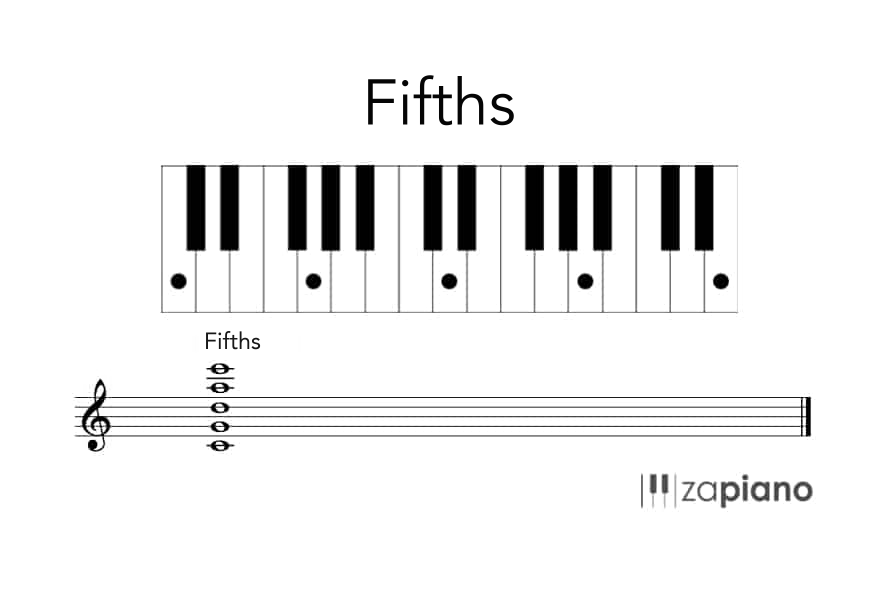
If we now arrange these notes within the range of one octave, we get the order C, D, E, G, A.
Major and Minor Pentatonic Scales
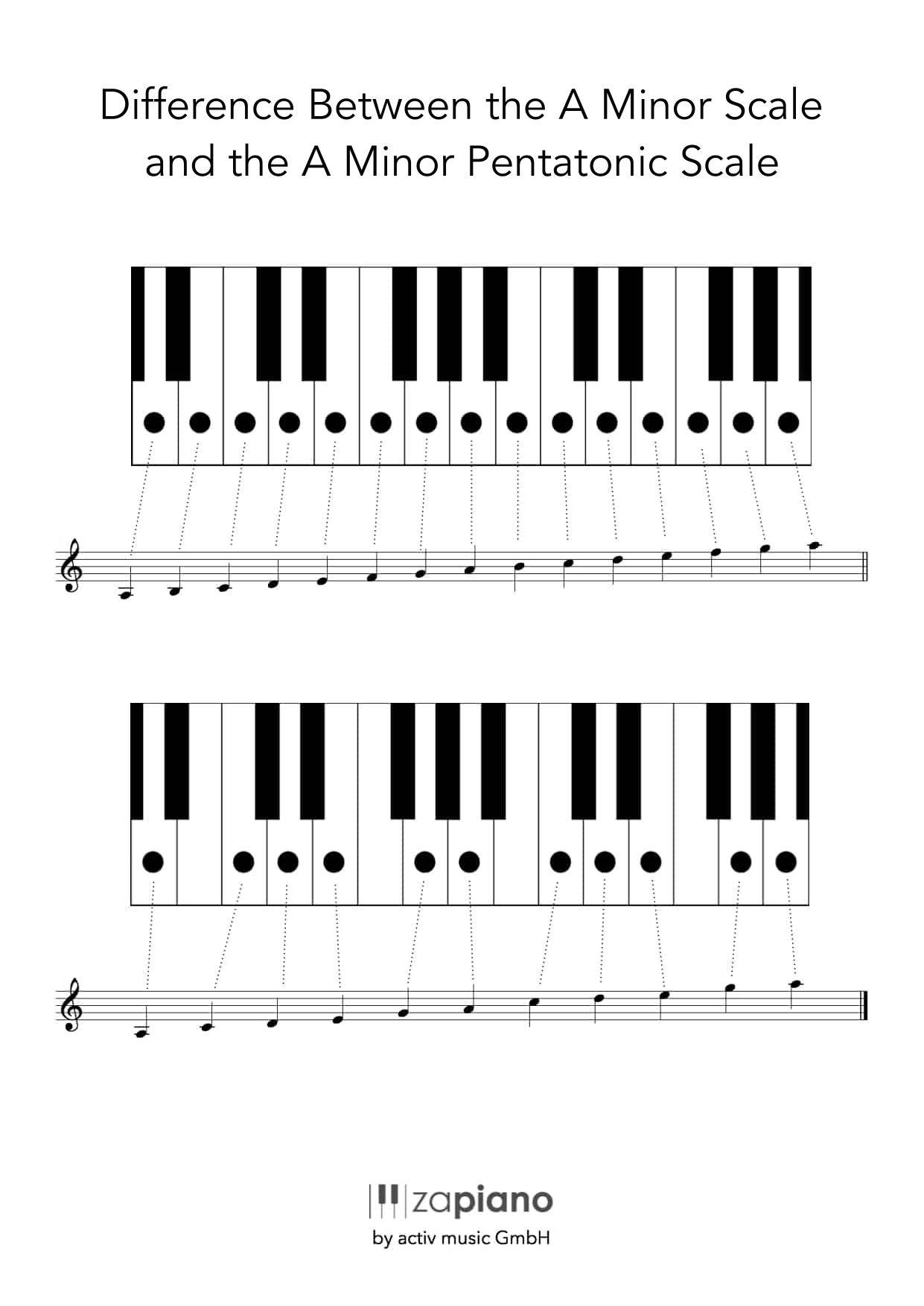
Maybe you’ve already wondered whether there’s also a minor pentatonic scale. The good news is that the minor pentatonic scale is derived from the major pentatonic scale. This means that the relative minor key of C major uses the same notes as the C major pentatonic scale, namely C, D, E, G, A. The relative minor key of C major is A minor. If we now arrange these notes by pitch, starting from A, we get the order A, C, D, E, G. And just like that, you’ve built the A minor pentatonic scale.
9. The Blues Scale
The blues scale has a very special place in conventional Western harmony. That’s because it deliberately uses a “wrong” note. For the blues scale, we add a diminished fifth to the minor pentatonic scale. Using the A minor pentatonic scale as an example, it looks like this:
A, C, D, Eb, E, G
So the blues scale contains 6 notes.
10. Exotic Scales
Of course, besides the diatonic scales, there are plenty of other scales. A few of them are:
- harmonic minor
- melodic minor
- symmetrical scales
- bebop scales
and many more … However, these are only relevant if you want to dive deeper into jazz and other styles.
Do You Have to Master All the Scales?
The question beginners often ask themselves is: “Do I have to master all these scales?” Yes and no. Of course, it depends on your goals. If you want to get deeply into improvisation and jazz piano, then knowing your scales inside out (and above all, being able to hear them!) is an absolute must. For the average player, it’s enough to understand the principle of diatonic harmony and then to really understand the modes in one key (important: at first, only in one key!).
I Recommend Learning to Play the Piano in C Major Only at First
Once you’ve understood how the diatonic system works and how the individual scales & chords are built, you can easily transfer this to all other keys. What matters, though, is that you first really internalize these principles. Among other things, I show you how to do that in great detail in the beginner course Piano Starter 1.
By the way: the circle of fifths offers a great graphic overview of all major and minor scales and how they’re related.