You’ve probably come across this question before: should you play the piano from sheet music, or would you rather play without it? Do you need to be able to read piano music? How important is it to practice reading piano notes? If you play without sheet music, how is that supposed to work, and how are you supposed to remember all the keys? Do you have to be a genius? And if you learn piano with sheet music – is that the safe route? Is it more serious? Are there disadvantages too? This blog post aims to help you and bring some clarity.
So: what are the advantages and disadvantages of learning piano notes?
One advantage is that there is a clear structure the pianist can follow. One disadvantage is that you can only be creative to a limited extent, and other valuable learning channels, such as your ear, are not engaged.
But there are even more disadvantages if you learn to play the piano only from sheet music. Read on and find out which mistakes you should definitely avoid.
When to Use Sheet Music & When Is It Better to Play Without?
First of all, it’s important to look at this question in terms of two basic styles:
- Classical pianists learn their pieces exclusively from sheet music – they interpret the compositions and try to come as close as possible to the composer’s idea of how the music should sound. The composer, in turn, added many detailed instructions to the works so that the performer can realize this vision.
- Modern pianists (pop, jazz, blues, etc.) mostly do without sheet music. A lead sheet (note: this is a highly simplified form of notation) is often used to play a song. The goal is the exact opposite of what was just described: instead of interpreting the piece as accurately as possible, you try to create a version of the piece that is as much your own as possible. Just listen to all the different versions of “Somewhere Over the Rainbow.” Then you’ll know what I mean. What matters most here is your ear, your understanding, your personal taste, your experience and so on when it comes to how you play a piece.

Music Notes on the Piano – What Do I Need to Know?
If you want to learn to read piano music as a piano player, you first need to internalize a few things. For example:
- the names of the notes on the piano
- fingerings
- sharps and flats and what they mean
- treble clef and bass clef
- groupings of notes (eighth notes, sixteenth notes, etc.)
- intervals
- chords
- and much more
Sure, that adds up to quite a lot. What’s important is that you start with very simple material. You internalize it and only move on once you feel confident.
It’s just like when you were a child and started learning to read. First there were just a few letters, then individual syllables, then short words, then little sentences, then longer sentences, then paragraphs … and in the end a whole book.
Many piano beginners want to play a particular piece that inspires them right away and quickly get hold of the sheet music for it. But this almost always ends in a crash landing – simply because the things mentioned above have neither been practiced correctly nor understood.
A good piece for practicing is my own composition Autumn Stroll.
Learning Notes on the Piano: How Do I Do It?
We all remember it from school – having to learn things by heart! Oh dear, most of us would rather not, and it’s no different here. “How am I supposed to learn piano notes easily and remember them all?” you’re probably asking yourself right now.
The important thing is to understand that learning to read piano music is a step-by-step process. It doesn’t happen overnight. Patience, stamina and even a bit of perseverance are needed here. Ideally, plan 10 minutes of pure note reading every day – you’ll be amazed at where you’ll be in a year.
Piano Notes Are More Than Just Black Dots: Understanding Sounds and Names
At first, it will be single notes within a certain range. Imagine: when you read the notes, you no longer look at your hands. This often raises the question: “So do I have to be able to play blind?” If you’re reading purely from the page, the answer is clearly yes.
That sounds scary, I know. But if you practice the ranges one at a time and then keep the left hand in the bass clef very simple at first, you’ll quickly experience success. That’s exactly how I’ve prepared it for my students in the course Piano Starter 1 – on your computer or conveniently via app.
Besides single notes, notes can of course also be played at the same time. In notation, they are then written one above the other. Now you can see right away how important it is to start very simply. Because as soon as notes are stacked on top of each other, you should be absolutely sure which key you’re in and which fingerings are most common.
From this point on, they’re not just black dots anymore – the music now has several voices. These are called chords. They in turn have specific sounds and names. If you also understand the logic behind them, you’ll soon be able to change the chords and shape pieces to your own taste.
We teach our students to practice in a holistic learning process that involves all sensory channels. This gives them the opportunity to change things and play several versions of a piece right from the start.
From here on, it’s no longer just about reading piano notes – understanding, your ear and your personal taste now play a role too.
So What About the Clef When Learning Notes?
When you look at classical piano music, it looks pretty confusing. Left hand and right hand written at the same time – all well and good, but there’s something else that’s crucial: the clef. There are actually two different ones:
- the treble clef
- the bass clef
The treble clef is the clef in which the right hand is written. It is also used for many other instruments. Most singers and the lead sheets in jazz and pop use this clef as well.
The bass clef is notated differently. Without going into detail, I just want to tell you briefly that here you have to learn where the notes are all over again. Ouch! That’s why I deliberately start my students with an in-depth focus on the treble clef. Only once they feel confident there do we move on to the bass clef.
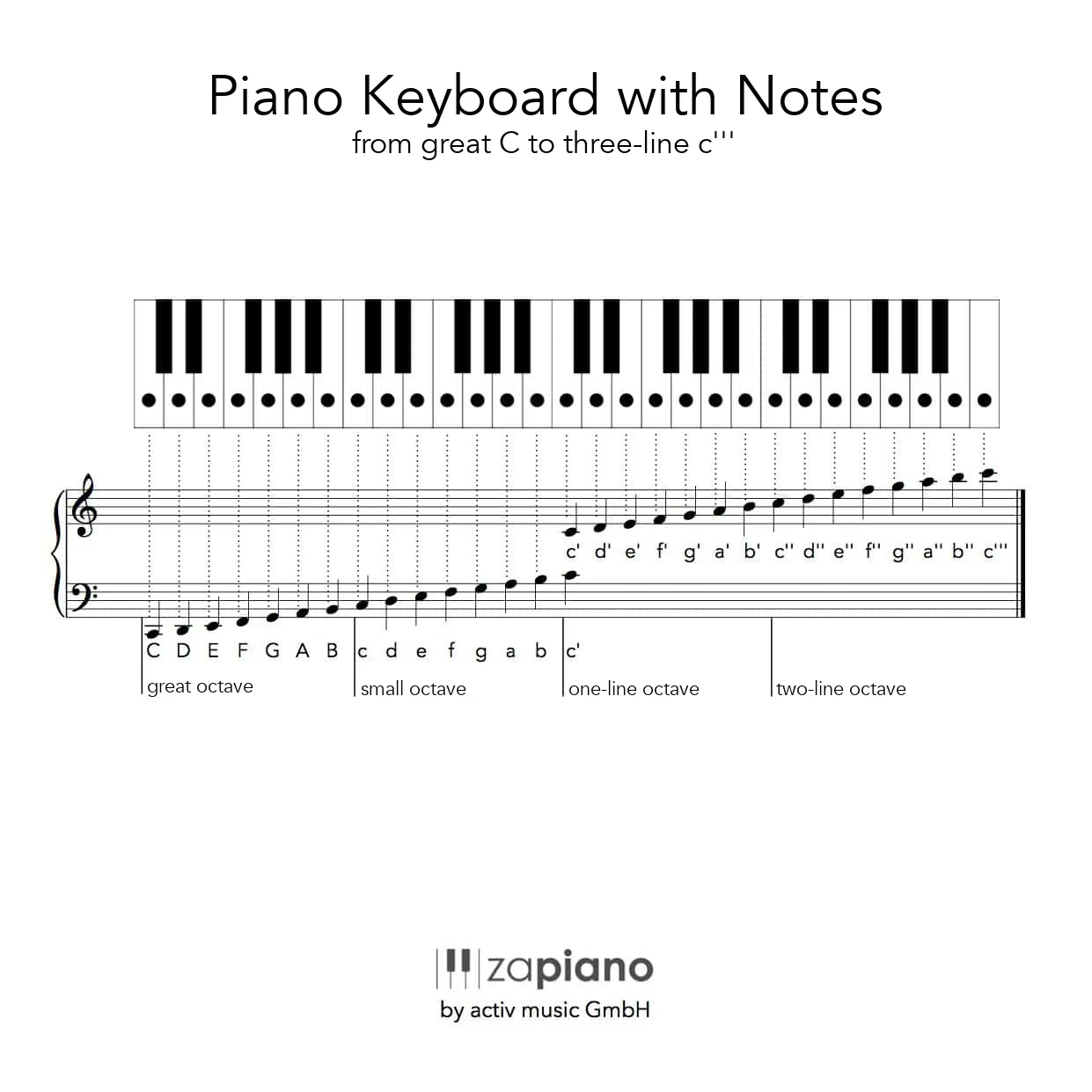
In the chart below, you can see where the two clefs meet. It is, so to speak, the middle of the piano. The note c’ (middle C) is also roughly where the tip of your nose is when you play the piano. Everything below this note on the left half, which we play with the left hand, is written in the bass clef.
Everything played above c’ on the right side is written in the treble clef. That’s the most important thing to understand for now.
Understanding the ABC of Notes
When you look at the keyboard, you’ll immediately notice a strong resemblance to the alphabet. If we name the notes going up from A, we basically get the ABC – the first seven letters of the alphabet:
A, B, C, D, E, F, G
From Pitch to Note Values
So far, I’ve written only about pitch, but of course every note also has a certain length. These lengths relate to the time signature, i.e. the meter written at the beginning of the piece. There are countless possibilities and rhythmic variations here. At first, though, only the following are important:
- whole note
- half note
- quarter note
- eighth note
At the beginning, I always make sure that my students have deeply internalized these note values. It makes no sense to move on before that. With the practically unlimited combinations of just these note values plus syncopation, you’ll be able to create really good piano music.
Over time, you’ll become familiar with recognizing groups of notes – that is, how several notes are combined and written together. Gradually, you’ll also get to know the intervals between the notes and automatically choose the right fingering. As mentioned above, over time you’ll also be able to read chords and decipher them instantly.