

If you have ever looked into keys and chords, you will have noticed that there are certain relationships between chords. Chords are not arranged completely at random – they are always related to one another, and within any given key they are arranged in the same way.
Keys, Chords and Scale Degree Theory
Think of it like this: in a family there are different family members, and each member has a role. It is exactly the same with chords within a key. This principle is known as scale degree theory. Scale degree theory can be derived from a major scale.
Diatonic Chords of the C Major Scale
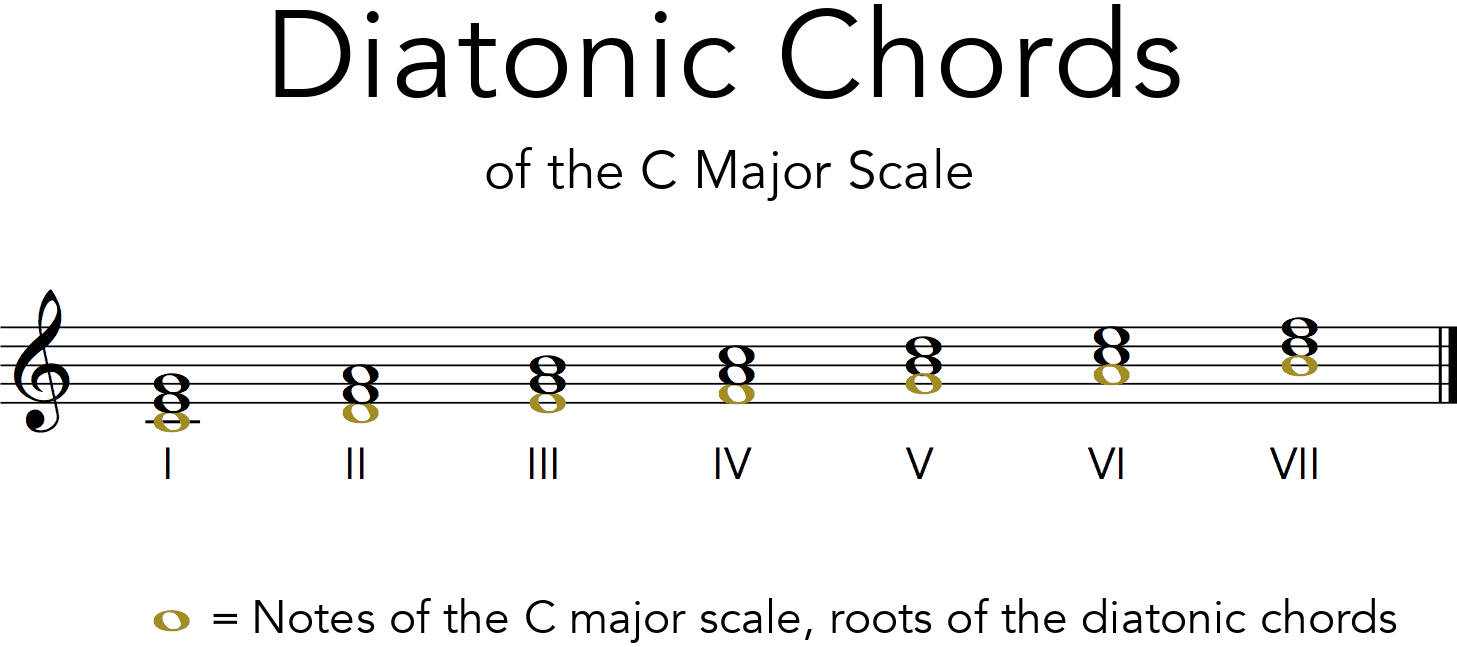
Let’s take the C major scale as our first example. On each note of the C major scale, a diatonic triad is built. Diatonic means that the chords are formed from the notes of the C major scale itself. A major scale consists of seven notes in total, so we get seven different diatonic chords. They are numbered in order, using Roman numerals. If we now take a closer look at these triads, we get the following chords: C, Dm, Em, F, G, Am, B°.
As you can see, we have a total of three major chords. They are on the 1st, 4th and 5th degree. We also find three minor chords, on the 2nd, 3rd and 6th degree. On the 7th degree there is a triad made up of two minor thirds – in other words, a diminished triad. Once you have understood this principle, you can apply it to any key. The circle of fifths helps you better understand the different keys, their key signatures and how they relate to one another.
Keys and Diatonic Chords of the D Major Scale
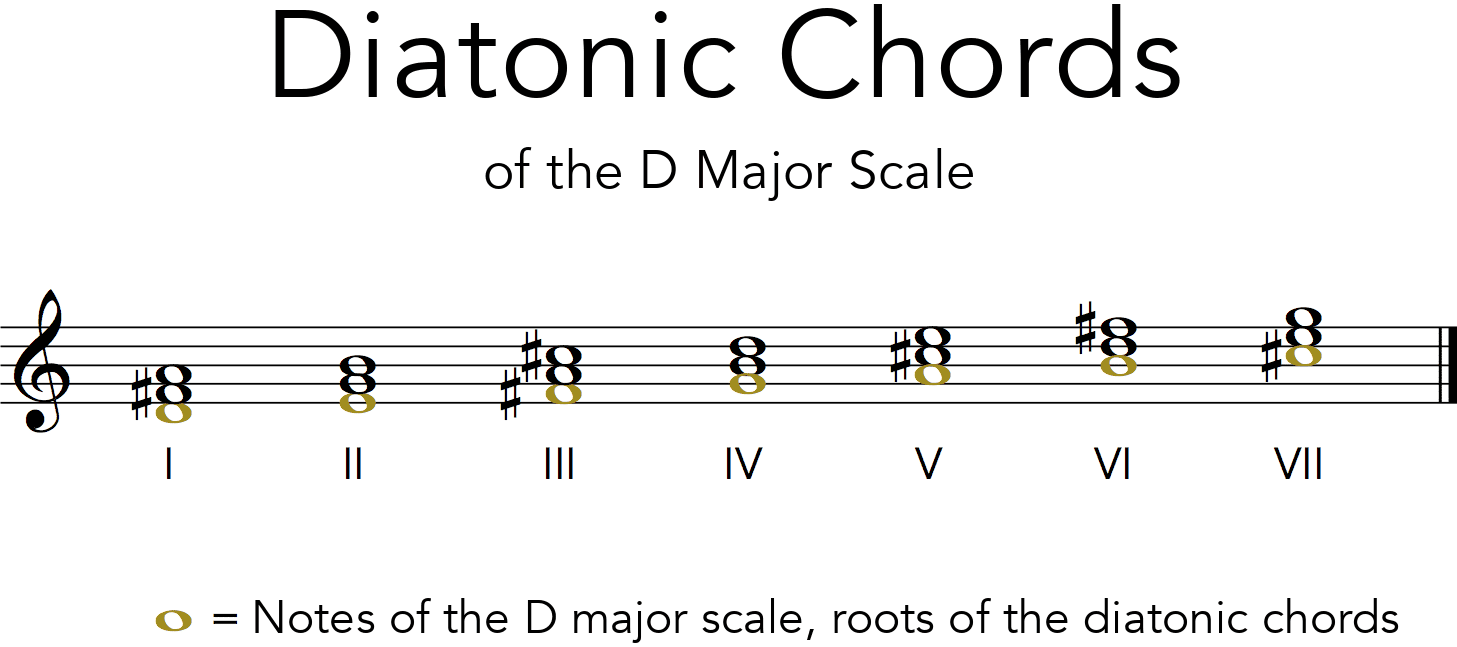
For comparison, let’s look at the diatonic chords in the key of D major: once again there are three major chords and three minor chords. The major triads are on the same degrees as in C major, namely the 1st, 4th and 5th degree. The minor triads are again on the 2nd, 3rd and 6th degree. And again there is a diminished chord on the 7th degree.
So the order of chord qualities is exactly the same in every major key:
- 1st degree = major
- 2nd degree = minor
- 3rd degree = minor
- 4th degree = major
- 5th degree = major
- 6th degree = minor
- 7th degree = diminished
This knowledge helps you transpose a song into a different key or better understand the harmonic relationships in a piece. It’s best to memorize this order once – then you can apply it to other keys and chords in no time. It also makes it easier to find chords that really fit together when you compose.
What Functions Do the Chords in a Scale Have?
So scale degree theory tells you the order of the chords in a key. You can now name the individual chords by their numbers and say: play me a II–V–I progression. Or a basic cadence (you can find a more detailed explanation on this page), which consists of the sequence I–IV–V–I. However, this does not yet tell you anything about how the chords relate to one another.
This is where functional harmony comes into play: it is another way of naming the chords within a scale while taking their functions into account. The main functions in a key are the tonic, the subdominant and the dominant. The tonic is on the 1st degree and is, so to speak, the “home” of the key – in Bb minor, that is the Bb minor chord (Bb, Db, F).
The dominant, which is always on the 5th degree, forms a counterpart to the tonic and is so full of tension that it wants to resolve to the tonic.
Compared to the dominant, the subdominant on the 4th degree is often perceived as a point of rest. In addition to these main functions, there are also secondary functions, which are found on the remaining scale degrees. Scale degree theory and functional harmony are two branches of harmony theory.
Besides major keys, there are also minor keys. Every major key has a relative minor key. In the case of C major, the relative minor key is A minor. Minor keys also have their own diatonic triads. If you want to learn more about scales, take a look at our article on the chromatic scale.
Keys and Diatonic Chords of the A Minor Scale
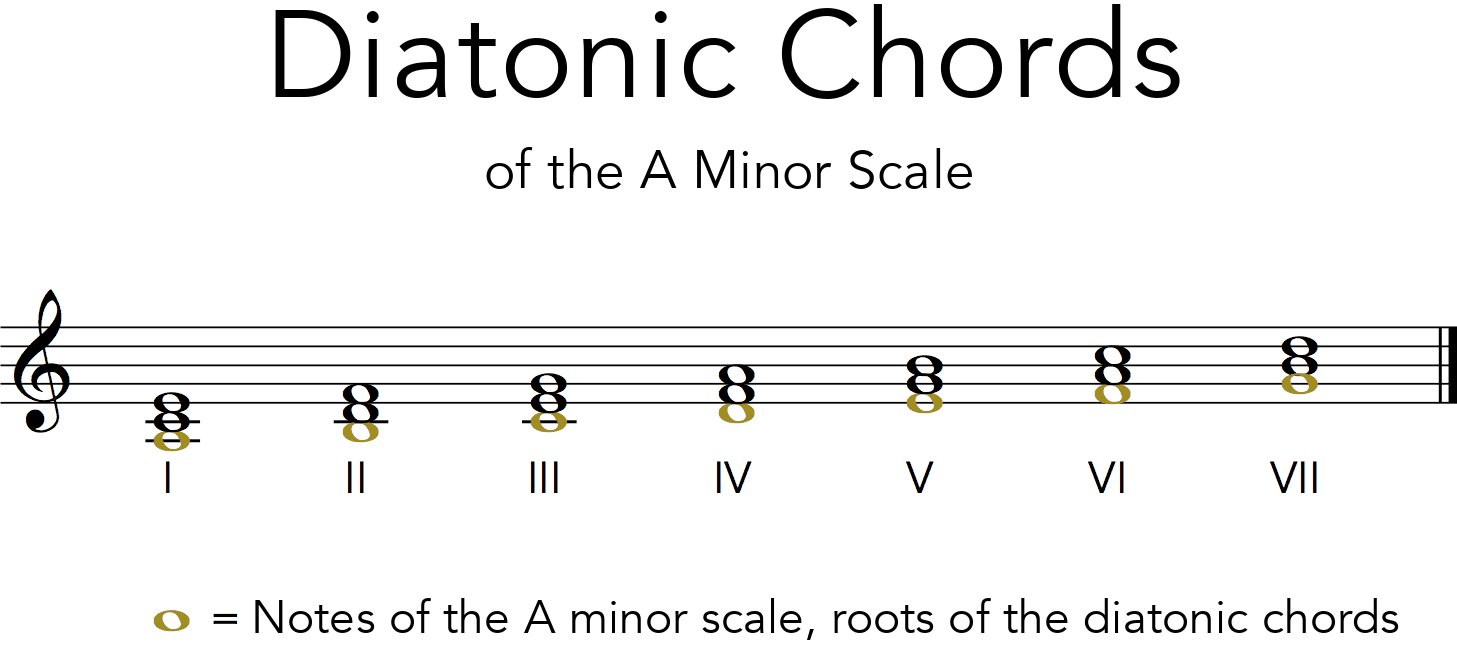
You may have noticed that the chords in the relative minor key are the same as in the corresponding major key. It’s as if you were looking at the order of the chords in the major key starting from the 6th degree. This gives you Am, B°, C, Dm, Em, F, G. These are exactly the diatonic triads of the A minor scale. For chord sequences like these to really stick, the right way of practicing is what counts.
Minor keys have another special feature: besides natural minor, there are also harmonic minor and melodic minor. Their diatonic chords are a little different and somewhat more exotic than in natural minor.
Once you have understood the principle of diatonic chords, you will be able to learn pieces much faster, because you will recognize the harmonic relationships in them much more quickly – how keys and chords are connected and which function each chord has within a key.
Try Learning Piano Holistically
If the topic of keys and chords has made you curious and you’d like to try learning the piano with Zapiano®, take a look at a free trial lesson. All you need to do is enter your name and email address below. This way, you can get a no-obligation taste of holistic learning with the Zapiano® Method. If you have any questions, feel free to get in touch via the contact form. We look forward to welcoming you to our interactive piano courses. Have fun exploring!