

Meter in Music: Dividing the Pulse
Music is an art form that moves us emotionally and at the same time follows a fascinating structure. Untrained listeners can’t recognize this structure, but anyone who has studied music more deeply immediately has a different listening experience (and hopefully enjoys listening even more!). If the underlying structure disappears completely, we perceive the music as chaotic.
One of the essential components of this structure is meter.
But what exactly does it mean, and why is it so important? In this article, I’ll explain what meter means and how it’s measured, and we’ll take a look at different time signatures and styles from around the world. And of course, at the end you’ll find some personal tips and my own experiences.
The Pulse: The Heart of Music
Every piece of music has a pulse, even if it’s sometimes subtle and barely noticeable. This pulse determines how fast or slow a piece is played and is measured in beats per minute (BPM). A slow pulse can have a calming effect, as in an adagio (approx. 60 BPM), while a fast pulse conveys energy and drive, as in a presto (from 160 BPM).
By the way: in bebop – a jazz movement from the 1940s – the tempo was deliberately pushed to extremes. Musicians wanted to test the limits and played over the most complex harmonies at a so-called “up-tempo.” That starts at around 220 BPM and goes up to around 300 BPM. Of course, the technical demands on the musician are enormous. But that’s just a side note.
Whether the music is slow or fast, the pulse stays constant and forms the foundation on which the rhythmic structure is built. Only when the pulse is divided into units of equal size do we get individual sections. This division of the pulse is then counted in a number of beats, and the result is the time signature, which is written at the beginning of every piece of music.
“C’est le ton qui fait la musique” – it’s the tone that makes the music, as the saying goes. But it’s the meter that gives a melody its contour.
What Is a Bar?
A bar, also called a measure, is a recurring unit within a piece of music, separated from the next bar by vertical bar lines in the sheet music. So much for notation – far more important, however, is hearing and feeling it:
– What meter is this piece played in?
– Do I feel the pulse? Can I hear where the “1” is?
With more complex pieces, this can be quite a challenge.
The time signature determines how many beats there are in each bar and what note value a single beat has. The most common time signature in Western music is 4/4 time, also called “common time.” It consists of four beats, with the first beat (the “1”) carrying the main accent and the “3” a secondary accent:
- 1 – main accent
- 2 – weak
- 3 – secondary accent
- 4 – weak
This simple structure makes 4/4 time extremely versatile, from classical music to pop, rock and jazz. Anyone who claps along while listening to a piece will instinctively pick out the “1,” as long as it’s a simple song. In jazz, for example, the art lies in no longer playing 4/4 time so “obviously,” but in playing around it with syncopation, creating a density of music that remains hidden from the “casual listener.”
Different Time Signatures and Their Characteristics
Although 4/4 time is extremely widespread, there are many other time signatures that belong to different musical styles and traditions. Here’s a selection:
Common Time Signatures
- 2/4 time: Often used in marches. The rhythm is clear and driving, perfect for military or festive occasions.
- Example: Johann Strauss I’s “Radetzky March”
- 3/4 time: Typical of the waltz. The rhythmic accent is on the “1,” and beats “2” and “3” feel lighter.
- Example: Johann Strauss II’s “The Blue Danube”
- 6/8 time: Characteristic of fast, flowing movement, as in Baroque music or Irish jigs. Here, the eighth notes are usually accented in two groups of three: 1-2-3, 4-5-6.
- Example: the traditional Irish jig “The Irish Washerwoman”
Odd Time Signatures – This Is Where It Gets Interesting
Odd time signatures have an asymmetrical structure and give music a special appeal. They’re often found in folk music and modern music.
- 5/4 time: This meter sounds unusual and exciting because it’s less familiar to Western ears. It’s often used in modern classical music and jazz.
- Example: “Take Five” by the Dave Brubeck Quartet (composed by Paul Desmond)
- 7/8 time: Especially common in Balkan folk music. This meter is often divided into smaller units such as 3+2+2 or 2+2+3 to make the rhythmic structure easier to grasp.
- Example: traditional music from Bulgaria or the Greek kalamatianos dance
- 9/8 time: Well known in Greek music, for example in the karsilamas dance. This meter can be divided as 2+2+2+3, which creates a lively momentum.
- Example: Greek folk music
Time Signatures and Musical Styles
Time signatures are often closely linked to certain musical styles and cultures. Here are a few examples:
- Blues: Often in 12/8 time. The swing feel of the blues creates a relaxed, storytelling character.
- Example: B.B. King’s “The Thrill Is Gone”
- Jazz: Often uses odd time signatures or complex polyrhythms to create unpredictable and dynamic rhythms.
- Example: “Blue Rondo à la Turk” by Dave Brubeck in 9/8 time
- Rock and pop: Mostly in 4/4 time, with the “backbeat” accent placed on beats “2” and “4.”
- Example: Michael Jackson’s “Billie Jean”
- Classical music: Uses a wide range of time signatures, depending on the era and composer. Some composers also experimented with unusual meters – Tchaikovsky, for example, wrote the second movement of his Sixth Symphony in 5/4 time.
- Example: Tchaikovsky’s Symphony No. 6 (“Pathétique”), 2nd movement
- Folk music: Whether it’s a Scottish reel in 4/4 time, a Bulgarian dance in 7/8 time or a Greek karsilamas in 9/8 time – folk music is rich in rhythmic diversity.
Conclusion: The Universal Language of Meter
Meter is much more than just a technical indication in music. It shapes the character of a piece, connects musicians with one another and is an expression of cultural identity. Whether it’s simple 4/4 time or complex 7/8 time – every time signature tells a story and creates room for creative interpretation.
The next time you listen to music, try to recognize the meter and feel the subtle accents and rhythms. It will help you understand the structure and the magic of music even better.
My Personal “Aha Moment” About Feeling the Meter
There were actually two such key moments for me as a musician. The first happened by chance. I was traveling and browsing through CDs in a second-hand store. Back then – it was around 2008 – music wasn’t streamed yet. In the “World Music” section, an interesting CD cover caught my eye: “Rhythm of the Chakras” by Glen Velez – someone I had never heard of before. Somehow the cover and the description appealed to me, and I bought it.
What I heard was the deepest and most moving thing I had ever heard when it comes to rhythm. Completely captivated from the very first moment, I began for the first time to truly feel the depth of a pulse and odd time signatures. My tip: listen to it as loud as possible on good speakers or headphones and really surrender to the sound. It’s a kind of trance and meditation. 🙂
The second experience for me was discovering “TaKeTiNa” by Reinhard Flatischler. During my music studies, rhythm was more of a head-heavy affair, with reading rhythms and clapping. There’s nothing wrong with that, but the actual “feeling” was left out. In his TaKeTiNa process, Reinhard Flatischler brought together influences from all over the world, and it’s based entirely on experiencing and feeling. In a group, you learn to feel (poly)rhythms – anyone who tries to analyze things with their head drops out immediately. It’s a bit difficult to explain! But I highly recommend it to everyone (including non-musicians!). The best thing to do is google TaKeTiNa and look for a TaKeTiNa teacher.
Almost forgot: through the Swiss drummer Pierre Favre, I first came into contact with “rhythm & movement.” I was about 20 years old at the time. This, too, was a lasting experience that I keep passing on to my students in my lessons. Every pianist has small movements and micro-movements in their hands and fingers. When these movements are fluid, this automatically has an effect on your piano playing. Training these movements away from the piano is an invaluable advantage.
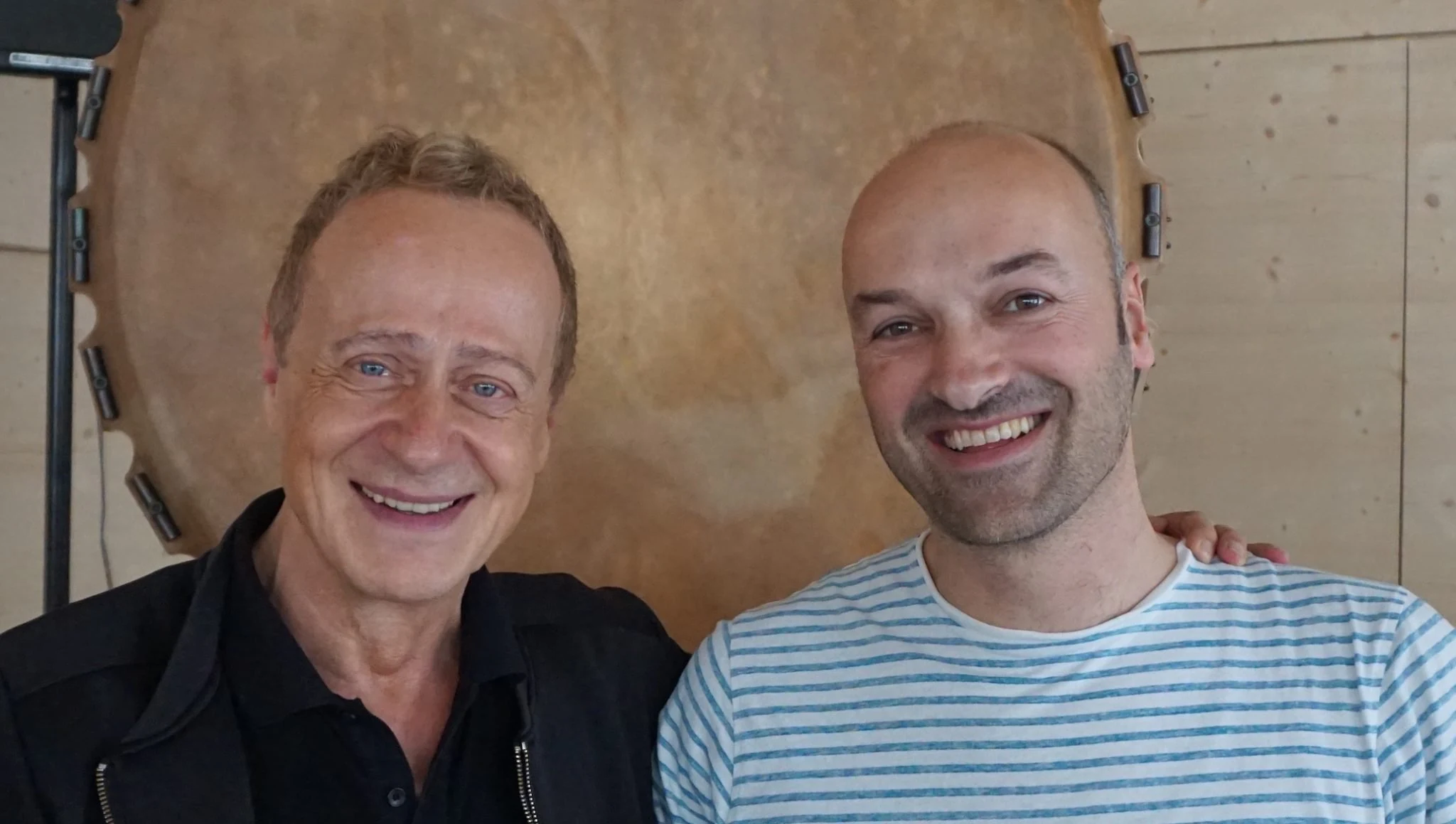
Here, I spent a weekend at a TaKeTiNa seminar with its founder, Reinhard Flatischler, himself.
By the way: I was so fascinated by these possibilities that I’ve even given team-building seminars myself on the topic of “Finding the Rhythm Together” – in a playful way, the team members connect with one another in a completely new way.
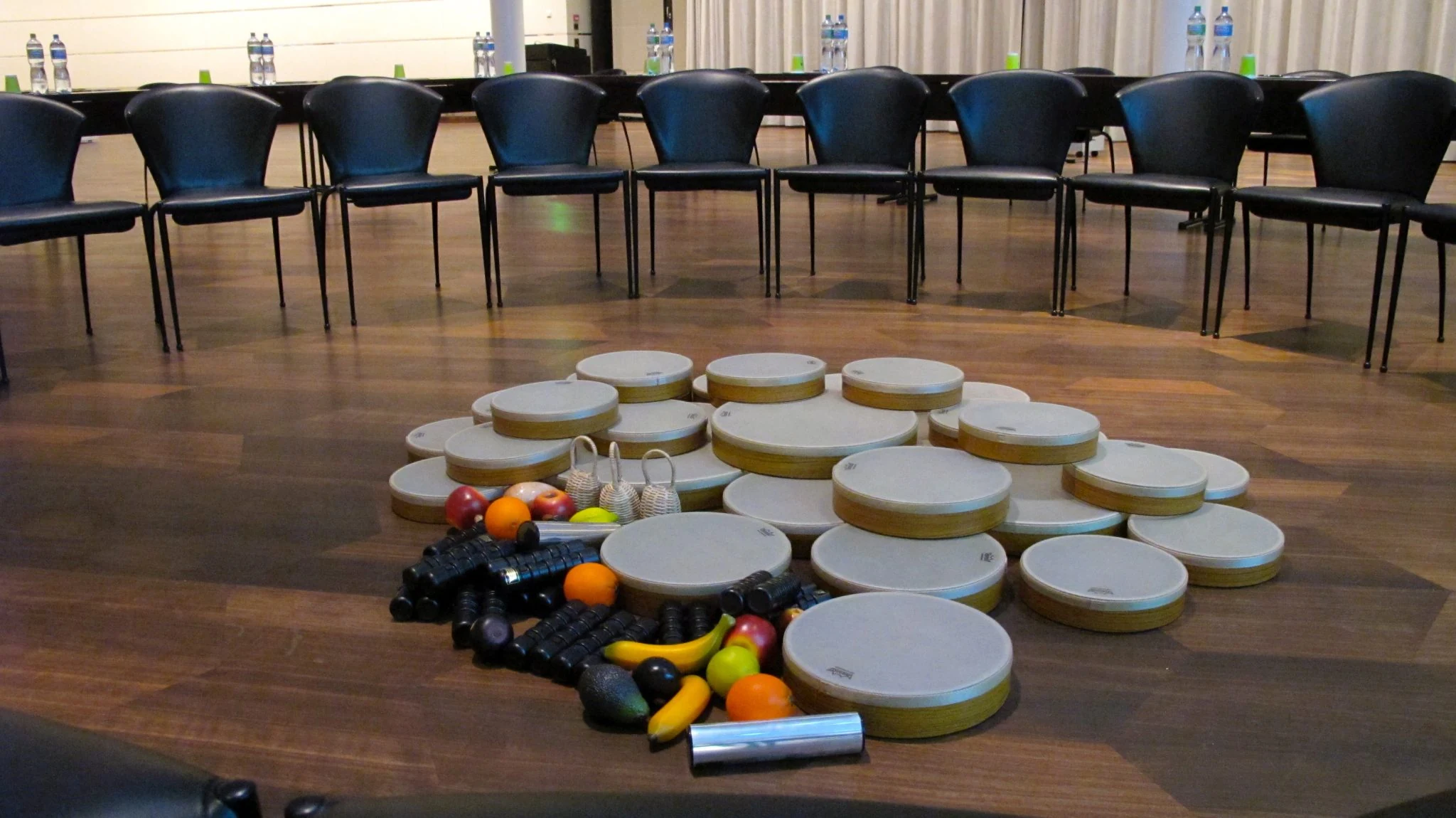
I always start the seminar with simple rhythm instruments, without much explanation. I invite the participants to grab any instrument and try to find a rhythm together. Of course, it’s interesting to observe who picks which instrument and who starts trying to convince the others of “their” beat.
This then leads to exciting discussions.
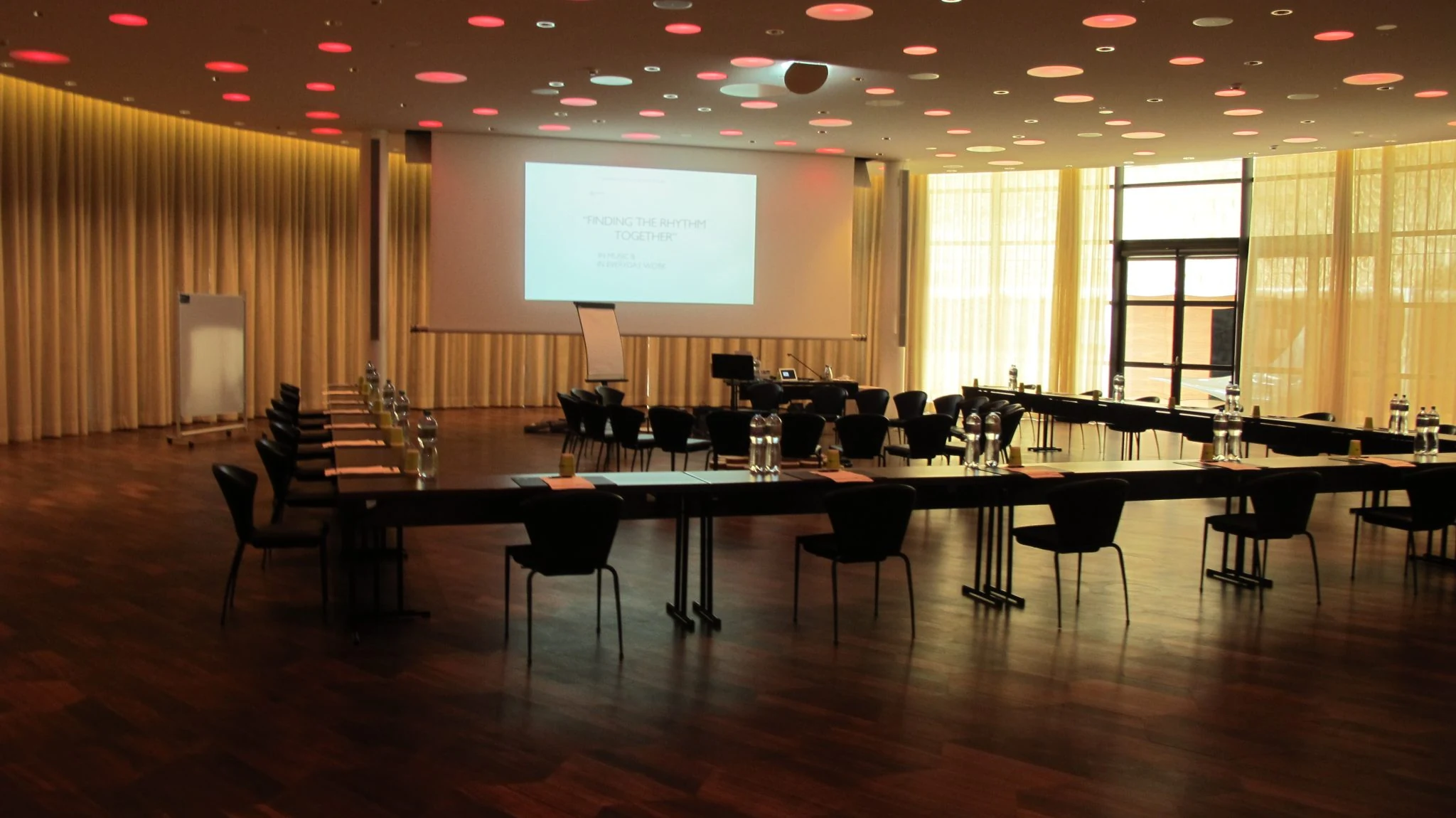
The seminar room at the “Dolder Grand” in Zurich: management training with a total of 80 participants on the topics “Finding the Rhythm Together” and “Building Trust in the Workplace.”