

Plenty of people know the terms – Major and Minor, Major Scale, Minor Scale, relative Minor Scale, Natural Minor Scale,… but what is Major and Minor exactly? Major and minor are the so-called tonal genders of music and are almost as different as man and woman.
This is because the major key (Latin “durus” -> hard) sounds rather cheerful and is often associated with positive things. The minor key (Latin “mollis” -> soft), on the other hand, tends to evoke a sad and sombre mood.
Now you’re probably wondering how it is that these two keys sound so different? The answer is quite simple: the distances between the individual notes are different in the major and minor keys. There are whole tone intervals and semitone intervals.

Nevertheless, you should not forget that this perception is of course always dependent on how you play the piece, at what tempo and whether it has vocals.
- Whole tone means that there is a black key between two white piano keys.
- Semitone means that there is no black key between two white keys. As you can see in the picture below, this is the case between the “e” and the “f” and between the ‘b’ and the “c”.
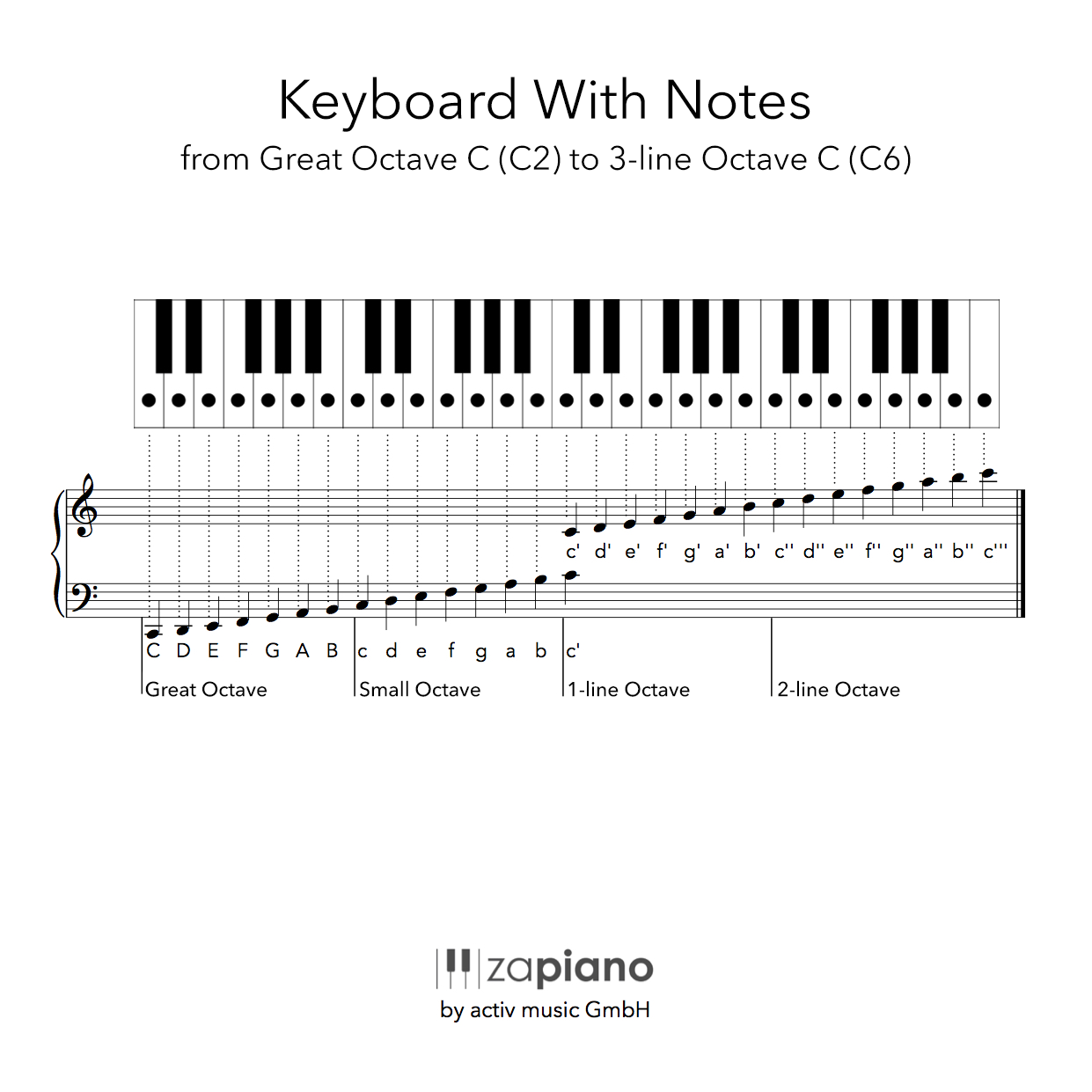
The scale – the structure
But now the question still arises as to what the structure of a major and minor scale looks like:
- There are semitones between the third and fourth notes and between the seventh and eighth notes. The major triad consists of a major third (four semitone steps).
- In a minor scale, the semitone steps are between the second and third notes and between the fifth and sixth notes. The minor triad consists of a minor third (three semitones).
The scale – the ladder of music?
Now that you know the main differences, let me explain the scale to you.
C Major Scale
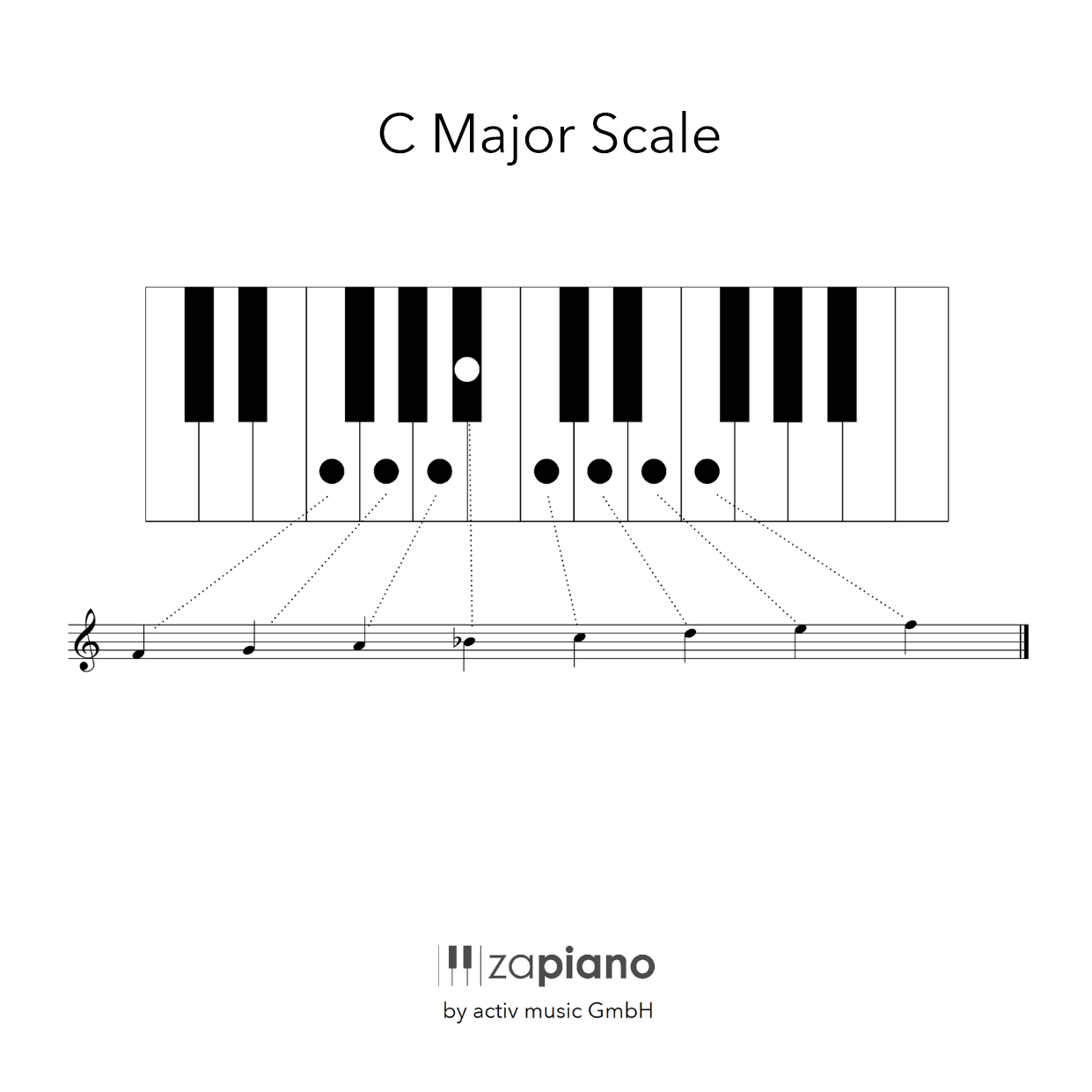
The simplest is the C major scale, as this only consists of the white piano keys. You start with the “c” and keep going up one key at a time until you reach the “c” again. Each major scale has a relative minor scale.
A Minor Scale
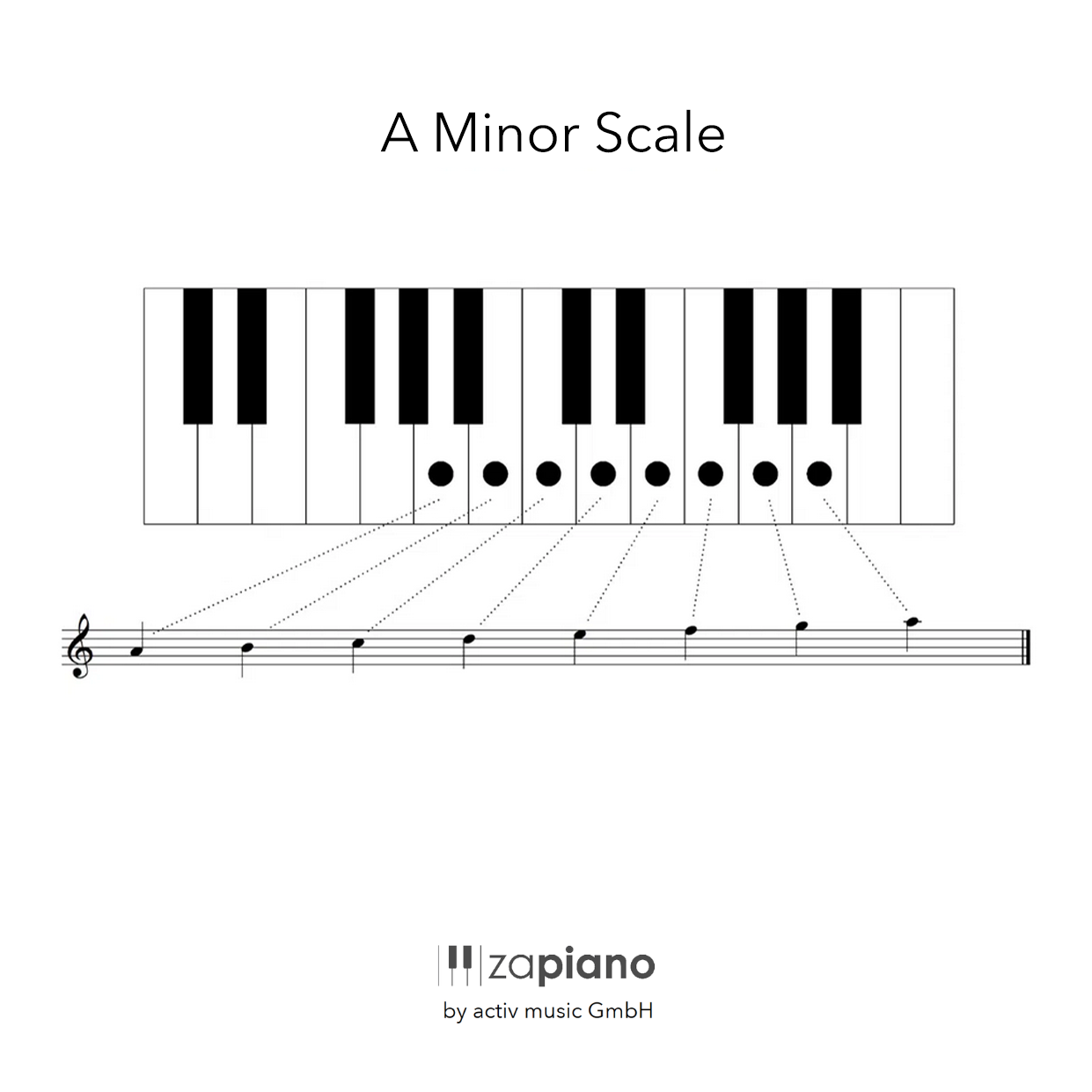
For an A minor scale, you start with the “a” and play the next 7 notes up or down until you reach the “a” again. There must be exactly eight notes in total, as this number of notes corresponds to an octave. Each octave consists of the same notes, just higher or lower than the previous ones.
There are many other scales in the major/minor system with different names. Basically, you name the scale after the first note you play. I have already briefly hinted at this above
So far, the whole thing is relatively logical: we take a piano key and play it and the 7 following keys. Then we have an octave that sounds great, right? If it were only that simple, we’d probably all be professional pianists by now … But look what happens when we start with the “f”.
F Major Scale

For example, if you now start with the “f” instead of the ‘c’ and simply play to the next “f”, you will quickly realize that this sounds somehow strange. The 1st and 8th note is an “f” in both cases. We now need semitone steps in the right places (3rd/4th, 7th/8th note). This is already given here at the 7th/8th position. To produce a semitone at the 3rd/4th position, you have to play a black key. In the “F major scale” this would be the ‘bb’ instead of the “b”.
So what does that mean for you now? You can start a scale with any key, but you have to pay attention to the semitone steps at the designated points so that the whole thing sounds harmonious.
Major and minor – different, but the same?
Introduction to the relative minor keys
A major scale has the same notes as its relative minor scale. Only the starting point is different – the notes remain the same. You can find the relative minor scale by going down a minor third (1 whole tone + 1 semitone) from the root of the major scale. The A minor scale is therefore the so-called “relative” to the C major scale. As a result, the notes also contain the same accidentals. In the case of the key of C major, we don’t need any (we are only on the white keys on the piano), for G major we need a # etc. You can find out more about this topic in our blog about the circle of fifths.

The “natural” minor scale – what is it?
Another interesting point is the so-called “natural” minor scale. This is also present in our example, as the A minor scale has no accidental, just like the C major scale. It is therefore important for you to know that if both scales have the same accidental, the minor scale is considered a “natural” minor scale. In technical jargon, this scale is also known as the Aeolian scale.
It is hard to imagine Western music without major and minor scales. The whole of popular music is based on this principle.
More harmony than ever? The harmonic minor scale
However, the ‘natural’ minor scale just explained does not always sound so harmonious. This is because the chord of the 5th degree (the dominant) with the “natural” minor scale would result in a minor chord. However, this would result in the missing leading tone, so that no harmonically introduced ending would be achieved. In order to achieve this, the dominant chord must be played as a major chord. In A minor, the chord of the 5th degree should therefore be an E major chord, so that “e”, “g#” and “b” are played. The “g” of the natural A minor scale, the 7th degree, is therefore raised to “g#”. But why only the 7th note? Because the 7th note is the “leading tone”! It “leads” back to the root note, so to speak. Because the leading tone is missing in the natural minor scale, it doesn’t sound as harmonious.
In addition, the name of the note also changes when it is played a semitone higher or lower. If it is raised, a “#" (sharp) is added, if it is lowered, a “b" (flat) is added.
. Here is an example:
- “g" for major = “g sharp"
- “g" for minor = “g flat"
However, there is also an exception! The “b” becomes “bb” at the bottom and if you play it a semitone higher, the notation is extended by a #.
Major and minor – the chords
So far I have only talked about the scale, but there are also major and minor chords. A chord is formed from the first, third and fifth notes of the scale of the same name. So there is also a C major and a C minor chord.
Would you like to find out more about all this and learn piano online with our interactive piano course? Then you can enter your name and e-mail address here and watch a free trial lesson first. For beginners, we recommend our Piano Starter 1, where you can learn to play the piano from scratch using the Zapiano® method. This means that we learn piano with all our senses: sight, hearing, touch, understanding and feeling. This holistic approach enables us to memorize what we learn much better.
All you need is a tablet and a piano. Then you can get started right away. If you have any questions while learning, you can ask them right below the lesson. As a Zapiano® student, you also have the opportunity to send us a video of your piano playing once a month. You will then receive feedback from one of our Zapiano® coaches and receive valuable tips and tricks. If you like, you can also exchange ideas with like-minded people in the Zapiano®Community. If you have any questions about our piano courses, please feel free to contact us at any time – we look forward to hearing from you!