

Anyone who plays the piano or gets involved with music in general will sooner or later wonder how many chords there actually are. Just take a look at a lead sheet or a piece of sheet music: major chords, minor chords, sus chords… Do you need to know them all? Should you know what a chord is? For every key? You’ll find the answers to these questions here. Just keep reading.
So: how many chords are there, actually? There are probably an infinite number of chords. The question is hard to answer precisely, because there are so many ways to build chords – and that in turn depends heavily on the musical tradition and style.
But if there are so many chords, do you have to know them all by heart? No, you don’t. It’s enough to understand the basic principles – and then to master them 120%. In this article, I’ll explain how to get started and which principles matter most.
A Basic Understanding of Chords
When you have a piece in front of you with a certain number of chords, the piece will first of all move within a particular key. You can think of each key as a room in a house. The chords that go together are all in the same room – in other words, in the same key.
So every key has a certain number of chords. They are always built the same way, and they’re called diatonic chords. But how many chords is that? Which chords belong to which key is a topic of harmony theory.
How Many Chords Are There?
The question of how many chords there are is hard to answer, because there are so many ways to build chords.
In Western music, the simplest chords are triads, which consist of three notes, and seventh chords (four-note chords, also called tetrads), which consist of four notes. But chords can also contain five, six or even more notes, especially in genres like jazz and progressive rock. There are also extended chords, which add notes beyond the octave of the root, such as 9th, 11th and 13th chords.
We can also consider different types of chords, such as major, minor, diminished, augmented and so on. Each of these chords can start on any of the 12 notes of the chromatic scale, which results in a large number of basic chords.
On top of that come the different inversions of chords (that is, the order in which the notes are stacked), the octave position, the exact voicing (the specific choice of notes and how they are arranged within the chord) and other musical aspects.
So if we take all these factors into account, there is in fact an infinite number of chords that could be created. It really depends on how we define a “chord" and how broad we want our definition to be.
How Many Chords Do You Need to Know?
As a beginner, you only need to understand major and minor chords. They are the most important ones.
In each key, for example C major, we have 3 major and 3 minor chords plus one diminished chord.
There are 12 major keys in total, and each of them in turn has 3 major chords, 3 minor chords and one diminished chord.
How many chords is that? Imagine you started right now and tried to memorize all of these chords without any context. I can already tell you one thing: you would be completely overwhelmed.
Start by Learning Only the (Diatonic) Chords of C Major
To begin with, choose the key that seems easiest to you, for example C major. Then you can start learning its chords – and in more depth than just from a chord chart.
Learn the notes of the chords, too. Once you know them, you can play the chords any way you like.
How Many Triads Are There?
Besides the question of how many chords there are, another question comes up: how many triads are there?
To answer it, you need to understand the following: a triad is a combination of three notes that can either be stacked in thirds (that is, every other note of a diatonic scale) or arranged in another musical structure.
The most basic types of triads in Western music are major, minor, diminished and augmented triads. Each of them can start on any of the 12 chromatic notes.
That makes 4 times 12, or 48 basic triads.
In practice, however, other factors can matter too, such as the octave position and the inversions of the chords, which increase the number of possible triads. For example, a C major triad (C–E–G) in root position has a different tone color than in first inversion (E–G–C) or in second inversion (G–C–E).
So depending on how specifically or broadly we want to define the “number of triads", the number can vary considerably. Besides triads, there are also seventh chords. You’ll find out what they’re all about in the next section.
How Many Seventh Chords Are There?
Seventh chords, also called four-note chords or tetrads, are chords made up of four notes. As with triads, the number of seventh chords can vary considerably depending on how broadly you define them.
The basic types of seventh chords in Western music are:
- Dominant 7
- Minor 7
- Major 7
- Minor-major 7
- Diminished 7
- Half-diminished 7
- Augmented 7
So there are 7 basic seventh chords.
If we apply them to all 12 notes of the chromatic scale, we get 7 times 12, or 84 basic seventh chords.
But just as with triads, the actual number of seventh chords can be increased by various factors, such as different inversions and octave positions. Every seventh chord can be played in four different positions: root position (with the root as the lowest note) and three different inversions.
That would increase the number of unique seventh chords to 84 times 4, or 336 chords.
And finally, if you take the different octave positions into account, the number of unique seventh chords could be increased even further.
But can we go even further? Are there also chords with five or six notes? Of course there are …
So our answer is: there are infinitely many chords. Getting even more specific than that is something for the experts only. We don’t need to worry about it just yet.
As you can see, the question of how many chords there are isn’t that easy to answer. It’s also important to keep in mind that in certain musical styles and traditions, including jazz and some contemporary classical music, the definition of chords and seventh chords can be expanded to create an even greater variety of harmonic possibilities.
Try Zapiano® Piano Courses
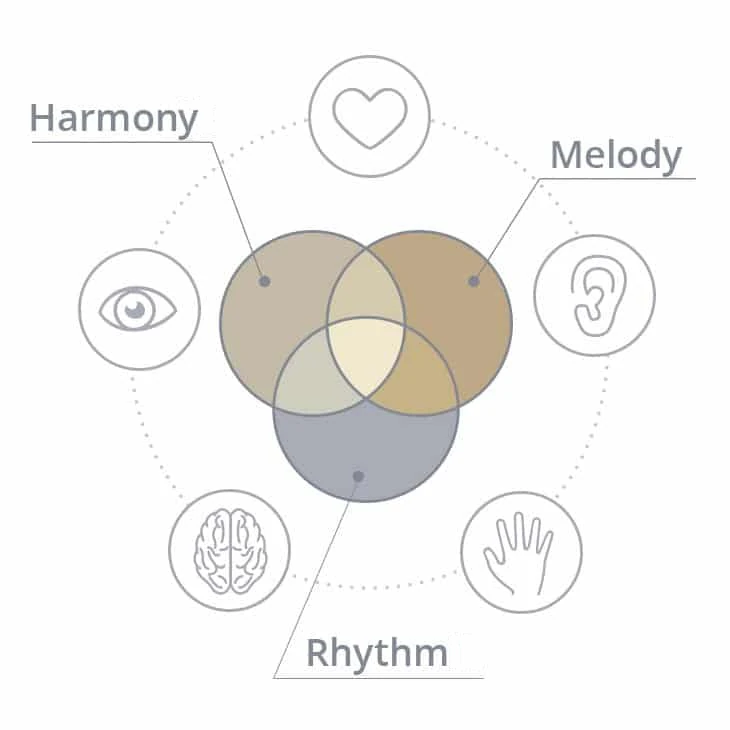
If you’d like to dive even deeper into this topic, I recommend the piano courses from Zapiano®. You’re welcome to try our beginner course, Piano Starter 1, with no obligation. You can sign up for a free trial lesson below. At Zapiano®, we learn to play the piano holistically according to the Zapiano® Method. This means that all of our senses are involved in learning.
If a question comes up while you’re learning, you can post it directly at the end of the lesson. Or you can get in touch via the contact form. Once a month, you can also send me a video of your piano playing. I’ll watch it personally and give you feedback with valuable tips. Just take a look. Below, you’ll find the free trial lesson 🙂