

Beginners on the piano often find it hard to read notes in the bass clef correctly and quickly. But even advanced pianists quite often have trouble with the bass clef. So you’re not alone! Here you’ll get a few tips and tricks on how to finally learn to read the bass clef properly. But first, let’s go back to the beginning and take a look at what the bass clef actually is.
What is the bass clef?
If you take a closer look at your sheet music for the piano, the first thing you’ll see is lots of lines. A staff (also called a stave) consists of five of these lines. In piano music, two staves are joined by a curved bracket. This brace groups together two staves that are played by one instrument, such as the piano. On the piano, the upper staff is usually written in the treble clef and the lower staff in the bass clef. The treble clef and the bass clef are the most commonly used clefs. Clefs determine which notes the five staff lines represent. That’s why every clef indicates a reference note that helps you work out the position of the other notes.
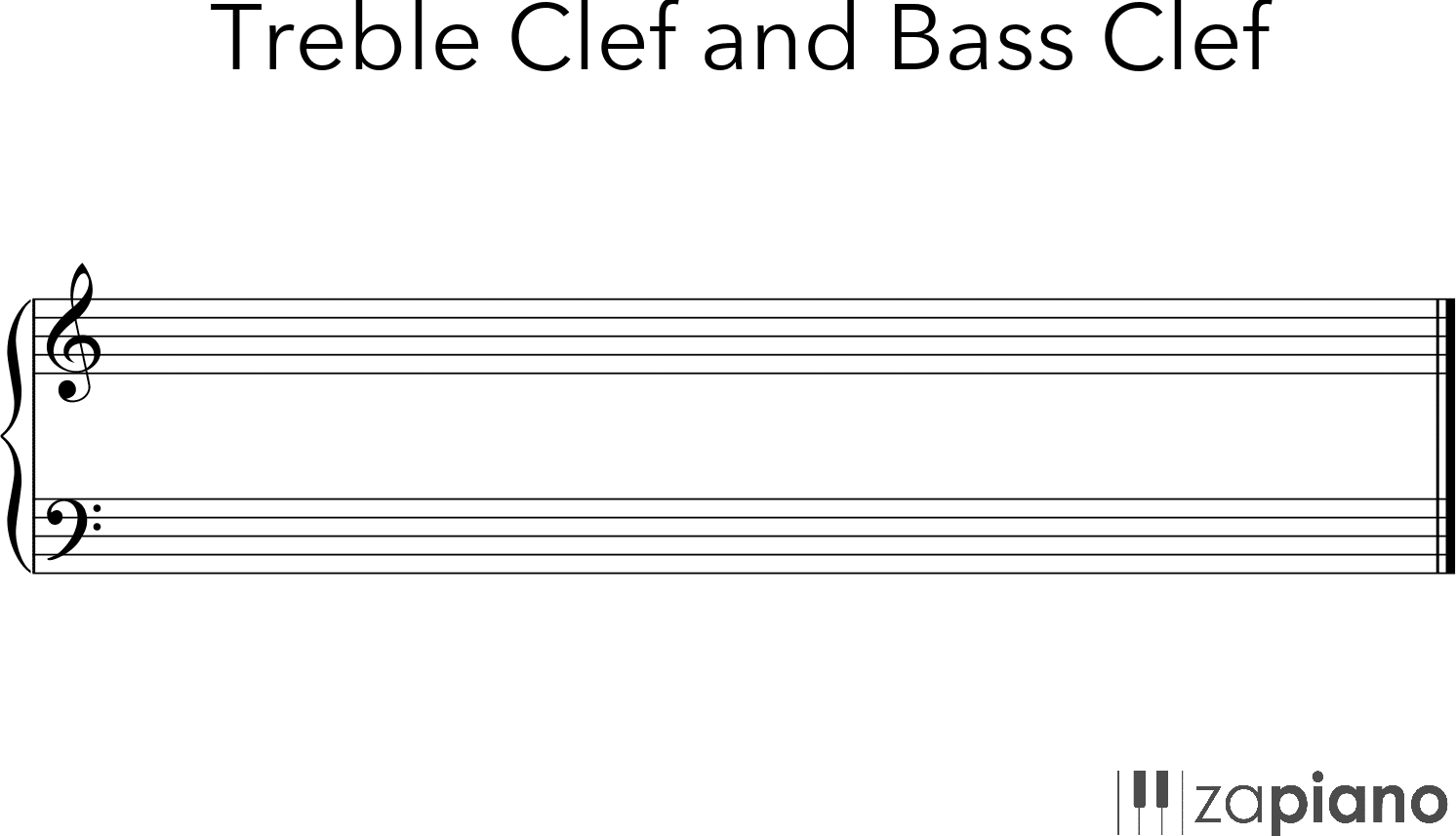
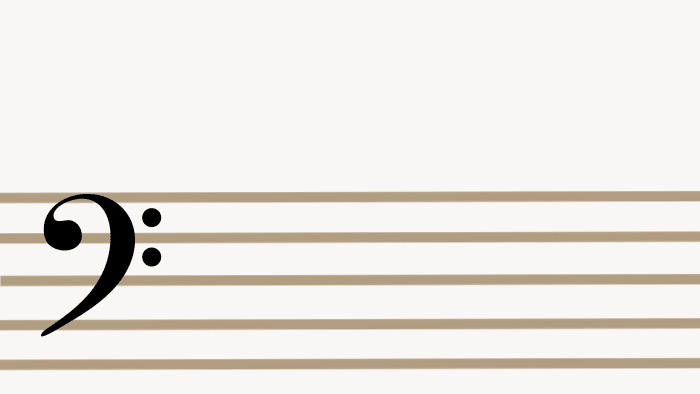
In the treble clef, this reference note is G. You can remember this by taking a closer look at where the treble clef sits on the staff lines: the “belly” of the treble clef lies on G. Because G is the reference note of the treble clef, it’s also called the G clef. You can read the reference note of the bass clef in the same way: the two dots of the bass clef surround the line on which F lies. That’s why the bass clef is also called the F clef. From the reference note of the treble clef, you go down four notes. From the reference note of the bass clef, you go up four notes. Either way, you arrive at the same C. So bass clef notation is the continuation of treble clef notation. With the two staves, the full range of a piano with its 88 keys can be represented.
Different clefs are better or less suited to certain musical instruments and vocal ranges. The treble clef, for example, is used for high voices, the violin, or the right hand on the piano. The bass clef is suitable for lower voices and lower string instruments such as the cello, and on the piano it is mostly used for the left hand.
Reading the treble clef and bass clef: tips, tricks and mnemonics
In piano music, the right hand usually plays the melody while the left hand accompanies the piece. That’s why beginners often learn the right hand first. As a result, both beginners and more advanced piano players often find it easier to read the treble clef.
Middle C is easy to find on your sheet music. To help you remember the names of the notes better, there are a few mnemonics for the treble clef:
- Starting from middle C and going from bottom to top, you can remember the notes on the lines of the treble clef with this sentence: “Every Good Boy Does Fine,” i.e., E, G, B, D, F.
- You can memorize the notes in the spaces between the lines with the word “FACE,” i.e., F, A, C, E.
There are also mnemonics for the bass clef that make reading the notes easier:
- Again, we start from middle C and look at the notes on the lines, this time from top to bottom: A, F, D, B, G. Read from bottom to top, they give you the well-known sentence “Good Boys Do Fine Always,” i.e., G, B, D, F, A.
- Now the notes in the spaces between the lines are still missing. This sentence helps you remember their position: “All Cows Eat Grass,” i.e., A, C, E, G.
By the way: if you just can’t remember what a note in the bass clef or treble clef is called, that’s no problem at all. With a very simple trick, you can “translate” a note from the treble clef into the bass clef:
- Let’s say you have a C in the treble clef.
- To translate it into the bass clef, think of the note two notes above C. That’s E, of course.
- So the note in the same position in the bass clef would be an E.
Learning to read the treble clef and bass clef on the piano, step by step from home
Through many years of experience, we’ve found that it doesn’t make sense to learn the bass clef right at the beginning. Often, even after a year, the student’s playing still sounds as if they were searching for the notes or typing on a typewriter. That’s why in our beginner’s course Piano Starter 1, we first focus on understanding and listening according to the Zapiano® Method. It’s based on logical, brain-friendly learning steps that everyone understands quickly and that can be adapted to any playing level. This also gets us making music faster. Feel free to try out Piano Starter 1: simply sign up below for a free trial lesson. Once the basics are in place, we then work on the bass clef in a targeted way.