

Why is learning chords so important? And what’s the best way to learn them? I’ll tell you all of this in this blog post!
Learning chords for beginners
In this blog, we look at the topic of learning chords for beginners. Here you’ll get answers to the most important questions you have as a piano beginner, namely:
- What are chords?
- Why should I learn chords?
- How is a chord built on the keyboard?
Learning chords and the big goals
When you start learning the piano, I’d like to give you a tip: set the big goals aside for now.
Of course, we all love to be inspired by artists and composers. And that’s a good thing. But don’t expect yourself to be able to play pieces like Yiruma’s “River Flows in You” right at the beginning. Always remember: these artists also had to learn to play the piano first and take lessons. Don’t set your goals too high too quickly, or frustration will soon set in.
Learning chords is a process
Learning chords and learning to play the piano is a process. And it’s definitely worth taking your time with it. According to our Zapiano® Method, we divide music into three areas: harmony, melody and rhythm. Then we look at each area on its own first. To start with, we limit ourselves to C major. In the Piano Starter 1 course, we take a very close look at this key. Now let’s get to the most important questions about “learning chords.”
What is a chord?
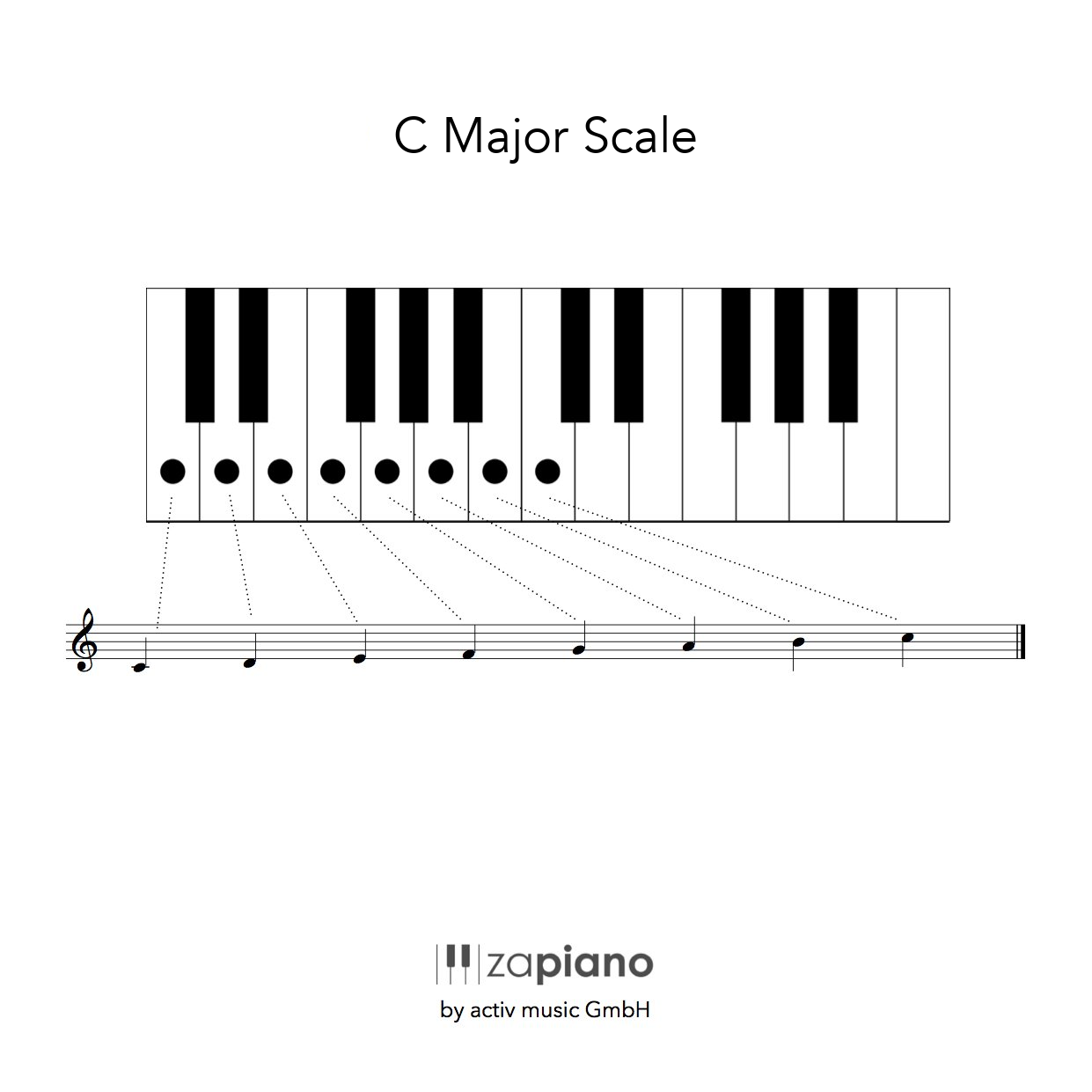
A chord is formed whenever you play three or more notes at the same time. A C major chord, for example, consists of the notes C, E and G. If you have a piece in C major, every note of the C major scale is part of the piece. On sheet music, you can recognize C major by the fact that it has no key signature. You can also see this in the image above.
Suppose we don’t have sheet music but a chord progression: then the first chord of the progression usually corresponds to the key of the piece. With a chord progression of C, F, Am and G, the key would therefore be C major.
Why should I learn chords?
When learning chords, the first important thing is that you know the notes on the piano keyboard. You really should know them by heart. Only then can you play the intervals between them with confidence.
This knowledge forms the foundation for everything else you’ll learn on the piano. It’s so immensely important because it keeps your brain from being constantly busy with micro-processes while you play. If you constantly have to think about where the “F,” for example, is on the piano keys while you’re playing, you’ll stumble and won’t be able to play fluently. That’s why this information simply has to stick. And don’t make the mistake of putting stickers on the keys. That can also get in the way of fluent playing. Just invest a few minutes and really learn the notes by heart. It’s definitely worth it!
If you’d like to learn more about this topic, take a look at our article on the chromatic scale.
How is a chord built on the keyboard?
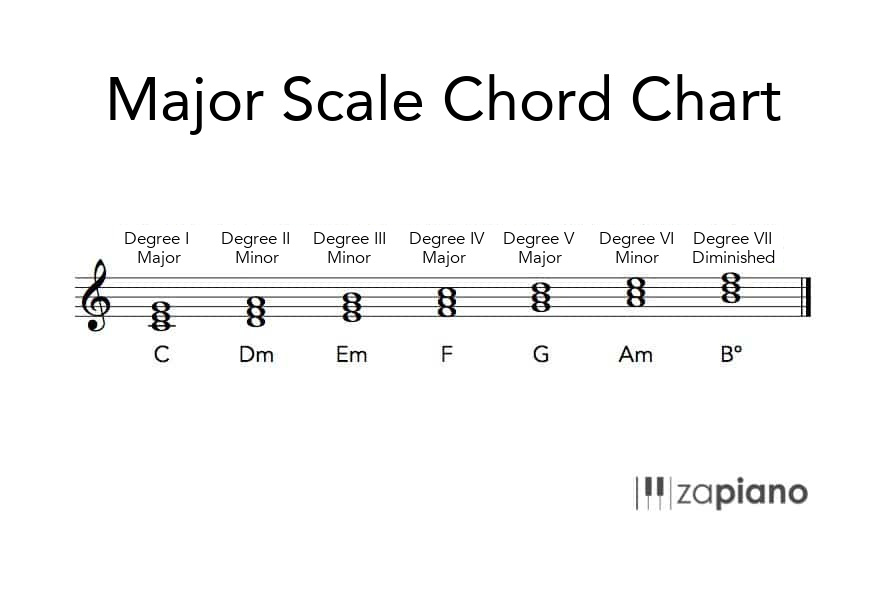
I recommend that you start by learning the chords on the degrees of C major – they are your introduction to harmony theory. There are six important chords:
- C major (C)
- D minor (Dm)
- E minor (Em)
- F major (F)
- G major (G)
- A minor (Am)
Building these chords is super easy: start on a note of the C major scale and add every other note of the scale on top – the third and the fifth. This gives you C–E–G, D–F–A, E–G–B, F–A–C, G–B–D and A–C–E. The chart above shows these chords in notation.
If you’ve become curious and would like to take a look at our foundation course Piano Starter 1, feel free to sign up for a free trial lesson. You’ll see that we learn the piano with a completely new method, the Zapiano® Method. This means that in our interactive piano courses, you learn to play the piano holistically. We don’t just play from sheet music, but also by ear and with a deep understanding of music. This makes learning the piano with Zapiano® creative, structured and sustainable. We design our courses so that practicing the piano is a lot of fun right from the start. Our students certainly can’t confirm the common prejudice that practicing the piano is no fun. So just give it a try. Have fun!