

You have probably heard the term chord inversion somewhere before. Especially if you want to learn the piano, it pays to learn this basic knowledge. It allows you to play new songs much faster, and over time you will move effortlessly across the entire keyboard. Utopia? Not at all – just read our blog.
A chord inversion means changing the order of the notes in a chord so that a note other than the root is in the bass.
That sounds very theoretical – but just take a look at the graphic.
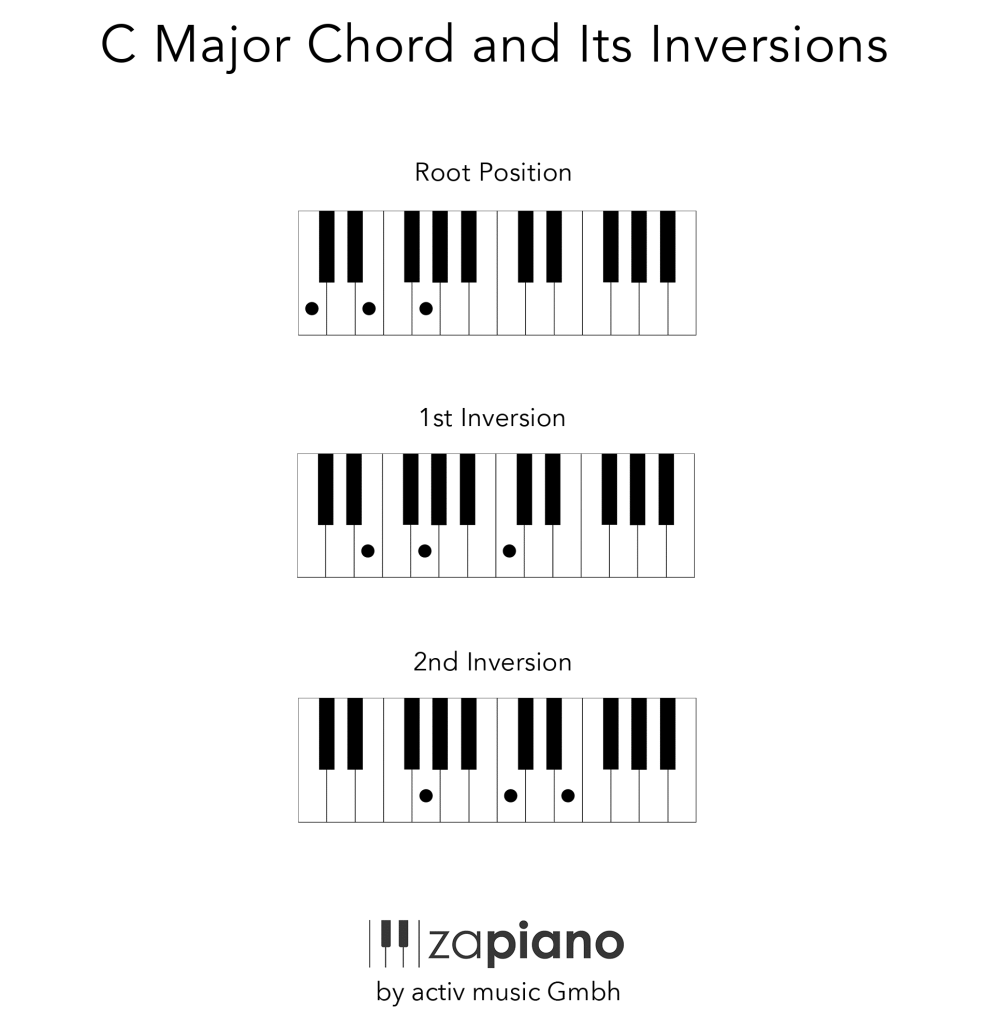
Rearranging the notes of a chord in this way gives the chord a slightly different sound without changing the actual notes of the chord.
That’s exactly the point: by rearranging the notes, the chord will sound a little different, but not completely different. A truly new sound only emerges when we place the bass note (e.g., the third) in the low register – then the chord will sound quite different.
A triad consists of three notes: the root, the third and the fifth. The third and the fifth are intervals, i.e., distances from the root. Let’s take the C major chord as an example, which consists of the notes C (root), E (third) and G (fifth).
- In root position, the root is in the bass (C – E – G).
- The first inversion (6/3 inversion) places the third in the bass (E – G – C).
- The second inversion (6/4 inversion) places the fifth in the bass (G – C – E).
Each of these inversions gives the chord a slightly different tonal color, even though it is still the same chord. Chord inversions are an important tool for composers and musicians to make the harmony in music more interesting and varied.

Is a Chord Chart Useful for Mastering Chord Inversions?
Only to a limited extent. If you rely solely on chord inversion charts, at some point you will end up with a huge muddle in your head – unless you have a truly photographic memory. In my 35 years of teaching experience, however, I have never met anyone who could do that.
It is much more important that you understand the logic behind the chords:
- Which notes does the chord contain?
- On which degree of the key is the chord built?
- How do I play the chord as a closed voicing or as an open voicing?
… and most importantly: how do you get to the next chord – where do the individual voices (notes) of the chord lead?
From a purely intellectual point of view, this last point is the most important one. And this process is never really finished. Once you dive deep enough into making music, you realize how infinite the phenomenon of making music really is. And that is exactly what makes it so beautiful.
How Many Chord Inversions Are There?
If we look at the 12 keys, each key has 7 diatonic triads (one on each scale degree). You might think that we now have to learn every chord inversion from scratch. Fortunately, that’s not the case – because the calculation would be:
-> 12 (keys) × 7 (diatonic triads) × 3 (root position and two inversions) = 252
That’s 252 chords to learn – and you would only have the “closed" version. Fortunately, the same chords appear several times in the different keys. Take C major, for example. It can be
- the chord on the first degree in the key of C major
- the chord on the fourth degree in the key of G major
- the chord on the fifth degree in the key of F major
The same applies to other chords. In every major key we have
- 3 major chords
- 3 minor chords
- 1 diminished chord
The major and minor chords always belong to a key in a specific arrangement (see diatonic chords). However, as described above, each of them can also appear in 2 other keys, as explained in the example above.
Can a Seventh Chord Also Be Played as an Inversion?
And if so, what are these inversions called? Yes, a seventh chord can also be played in different inversions. A seventh chord (four-note chord) is a chord made up of four notes, such as the dominant seventh chord (for example C7 – that’s how it is written).
The inversions of a seventh chord are as follows:
- Root position: The root is in the bass. This is sometimes called a 7 chord. The “7" simply means that the seventh is added to the triad. Depending on the chord type, the seventh can be a minor or a major seventh.
- First inversion: The third is in the bass. As a rule, this inversion is not specifically marked – unless a slash chord is used deliberately to make the chord progression smoother, or the composer absolutely wants this sound to be played in this particular context.
- Second inversion: The fifth is in the bass. Here, too, this inversion is usually not specifically marked – unless a slash chord is used deliberately to make the chord progression smoother, or the composer absolutely wants this sound to be played in this particular context.
- Third inversion: The seventh is in the bass. Here, too, this inversion is usually not specifically marked – unless a slash chord is used deliberately to make the chord progression smoother, or the composer absolutely wants this sound to be played in this particular context.
These inversions apply to various types of seventh chords, including major seventh chords, minor seventh chords, diminished seventh chords and half-diminished seventh chords. The inversions give the chord different tonal colors and are often used in composition and performance to create variety and harmony in music.