Why are there different keys? Why does this matter? When should you start working with keys? And are there principles that apply to every key?
A Short Crash Course in Harmony Theory
Here I give you a short crash course in harmony theory. Why do we actually need keys, and do you really have to master changing keys? What do you gain from being able to transpose a piece into a different key? That’s what this article is about.
Let’s start with the question of why keys exist at all. In Piano Starter 1, we work in C major first. Once you know your way around one key, you can transfer what you’ve learned to the next one. It makes no sense to learn as many keys as possible as quickly as possible without having internalized how a key is built in the first place. As a beginner, it’s a good idea to stay with the C major scale for quite a while. After that, you can get to know other keys.
Why We Need Keys
Maybe you’re wondering why keys make sense at all. Perhaps you’ve tried singing along to a song before. Sometimes a song is much too high for your own vocal range – or too low. Everyone feels comfortable in a different range. That’s why it’s so important to be able to transpose songs at the piano – that is, to move them from their original key into a different key. So I recommend that you get to grips with keys. Most digital pianos have a transpose function: you play in a key you know well, such as C major, but the digital piano plays the song in Ab major if you’ve set the transpose function that way. That’s handy, but I wouldn’t recommend it, because it doesn’t help you develop as a piano player.
To some extent, every key also has its own tonal color. Some have a rather “darker” character, others a “brighter” and “friendlier” one. Flat keys usually have a somewhat darker tonal color, sharp keys a brighter, clearer one.
What Do I Need to Learn Keys?
If you get into harmony theory a little, learning different keys is actually relatively easy. When you learn keys at the piano, be aware that it takes some time before you can apply different keys on the piano.
How Many Notes Are in a Key?
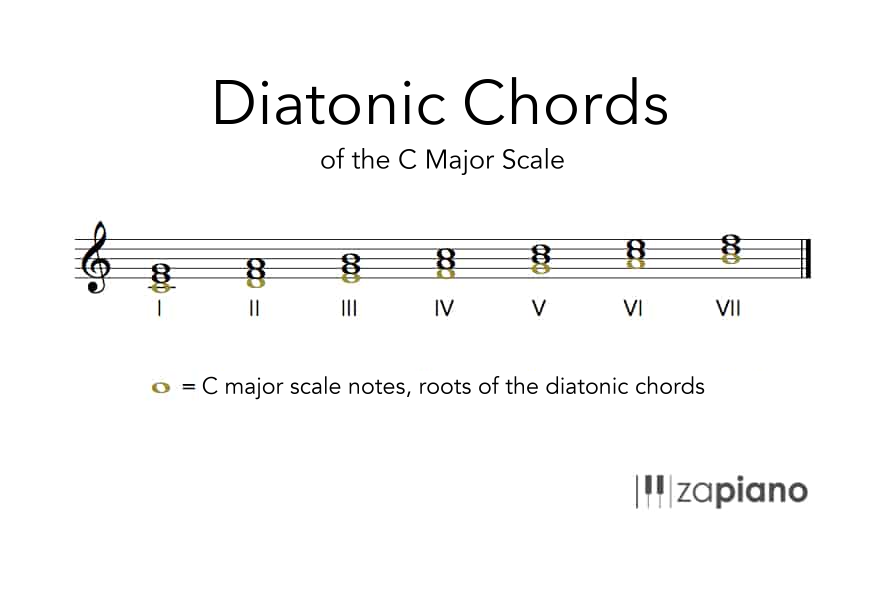
Every key always has seven different notes. On each of these seven notes, I can build a chord. So there are seven different chords in a key. I already explain these principles in Piano Starter 1, because they’re so important for understanding.
But how many keys are there altogether? A key can be built on each of the 12 notes of the piano keyboard, so there are 12 different major keys. The circle of fifths helps you get a clear overview of these keys, their key signatures and how they relate to each other. That’s why it’s so important that you first master one key, such as C major, really well and then slowly add new ones to your practice, one by one. At first, it’s enough if you can use the most common keys on the piano. Every major key also has a relative minor key, which is always built on the 6th degree of the major scale – so in total there are 12 major and 12 minor keys.
How Should I Start Learning Keys, and How Many Should I Learn?
To start with, you can play a I-IV-V-I chord progression in root position.
- In C major, these are the chords C, F, G, C.
- Now try transposing them to F major. Then you get the chords F, Bb, C, F. You’ll find the notes in the F major scale.
- Or try playing this I-IV-V-I progression in G major: then the chords are G, C, D, G. You’ll find the notes in the G major scale.
- A good next step is the D major scale: there, the chords are D, G, A, D.
- And if that comes easily to you, add the E major scale: there, the chords are E, A, B, E.
The first three are very easy to play. Your goal should be to play this chord progression comfortably, without having to think much about it. It’s very helpful to also say the name of each chord out loud while you play the chords.
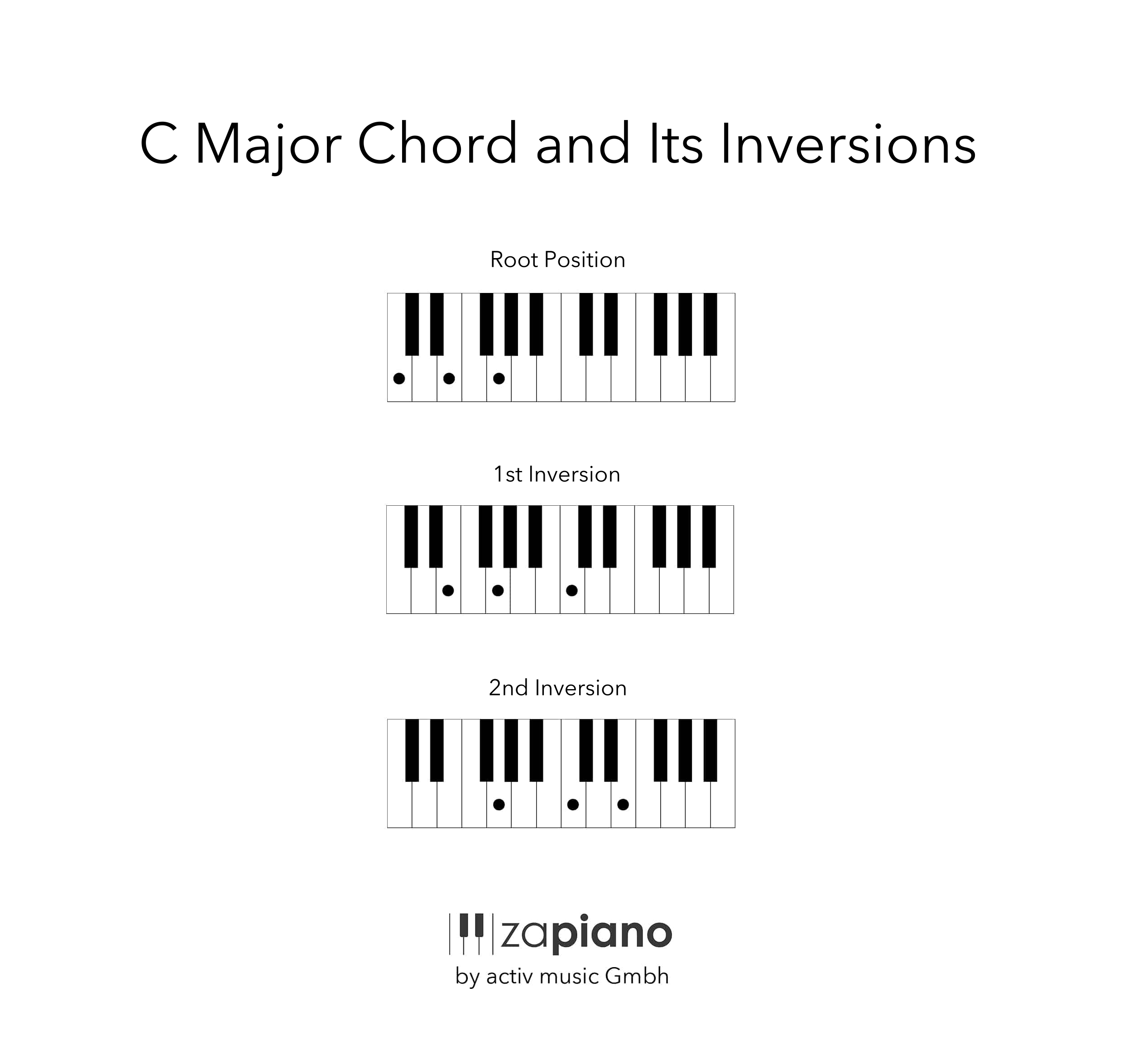
Once that works, you can try the whole thing with chord inversions. In a I-IV-V-I progression, for example, you can play the first chord in root position, the second chord in second inversion, the third chord in first inversion and the fourth chord in root position again. In Piano Starter 1, I explain in detail how to play chords and chord progressions in different inversions. In the graphic below, you can see the inversions of the C major chord. If all of this still feels too complex, feel free to try a free trial lesson – you can order it at the end of this article. Have fun!