

You’ve probably heard the term “interval" before. But what exactly is an interval? We looked into this question and put together some important information for you.
What does interval mean? In music, the distance between two different notes is called an interval. Within an octave we have 12 notes and, accordingly, a range of different intervals. Each interval is named according to the diatonic scale.
That’s the theoretical explanation. In practice, however, we don’t work this way, because intervals are always related to a scale. Once you know the formula of a scale, it becomes the reference for the intervals. Counting semitones is theoretically correct, but it’s never done this way when you’re actually making music.

What Characterizes Intervals?
Intervals can be classified by their quality (perfect, diminished, augmented) and by their distance (unison, second, third, etc.).
Here are the intervals, using C as the root:
- Unison (prime): both notes are identical.
- Second: one semitone (e.g. from C to C#) or two semitones (e.g. from C to D)
- Third: three semitones (e.g. from C to Eb) or four semitones (e.g. from C to E)
- Fourth: five semitones (e.g. from C to F)
- Fifth: seven semitones (e.g. from C to G)
- Sixth: eight semitones (e.g. from C to Ab) or nine semitones (e.g. from C to A)
- Seventh: ten semitones (e.g. from C to Bb) or eleven semitones (e.g. from C to B)
- Octave: twelve semitones (e.g. from C to the C in the next octave)
The perfect intervals are the unison, the fourth, the fifth and the octave.
By the way, there’s no such thing as an “imperfect" interval. My students usually ask me about this after learning the first basic terms here.
If a fourth is lowered, the technical term is a diminished interval (diminished fourth). Since this interval sounds the same as a major third (enharmonic equivalent), it’s rarely used in practice. If the fourth is raised, it’s an augmented interval (augmented fourth).
If a fifth is lowered, we speak of a diminished interval (diminished fifth). If the fifth is raised, we speak of an augmented interval (augmented fifth).
Keep in mind that most of these intervals also come in a smaller and a larger version (for example a minor third compared to a major third). In addition, fourths and fifths can also be described as diminished or augmented, which means they are one semitone smaller or larger than the usual version of that interval.
Now We Have the Intervals, but We Don’t Know Yet Whether They’re Major or Minor.
Let’s say we only use the C major scale and want to know what these intervals are called. Here’s how it looks:
- Unison (C to C) – perfect unison
- Second (C to D) – major second
- Third (C to E) – major third
- Fourth (C to F) – perfect fourth
- Fifth (C to G) – perfect fifth
- Sixth (C to A) – major sixth
- Seventh (C to B) – major seventh
- Octave (C to C) – perfect octave
The terms “perfect" and “major" refer to the size of the interval in a diatonic context. The perfect intervals also have a self-contained sound without any tension. By the way, if we only use the white keys on the piano, we’re automatically in the key of C major. The examples of diatonic intervals above are nothing other than the C major scale.
Take a look: in this graphic we’ve illustrated how it all fits together:
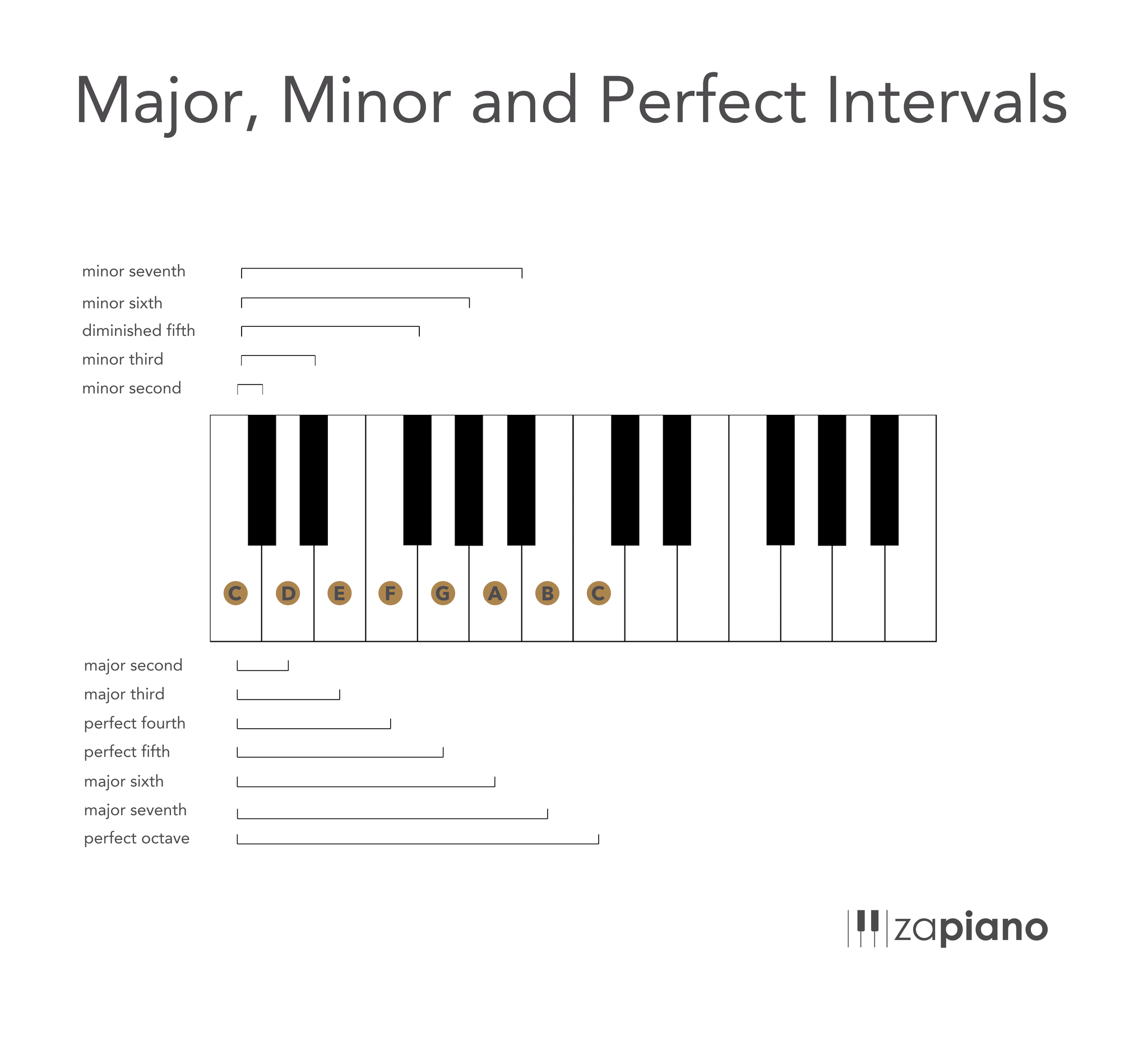
But why are intervals so important? Because intervals are fundamental building blocks of music. They form the basis for chords & melodies. Recognizing intervals by sight, understanding them and hearing them is an essential part of any musical education.
What Are Melodic Intervals?
There’s no uniform textbook definition for this. In general, an interval is perceived as melodic when it follows the major scale from bottom to top – so, as described above, every interval within the octave starting from the root C. The interval most often described as “pure-sounding" is probably the major third.
Melodic intervals are often easier to remember if you think of a particular piece you know well.
Here are some song examples that help you remember melodic intervals. Each one refers to the first and second note of the melody:
– major second: “Frère Jacques".
– major third: “When the Saints Go Marching In".
– perfect fourth: “Here Comes the Bride".
– perfect fifth: “Twinkle, Twinkle, Little Star" (between the 2nd and 3rd note)
– octave: “Somewhere over the Rainbow".
What Is a Complementary Interval?
It gets interesting when you look at the C major scale from the top down and then compare the intervals. All major intervals now become minor intervals. The perfect intervals stay perfect.
- C – B (minor second downward): its complementary interval (upward) is the major seventh.
- C – A (minor third downward): its complementary interval (upward) is the major sixth.
- C – G (perfect fourth downward): its complementary interval (upward) is the perfect fifth.
- C – F (perfect fifth downward): its complementary interval (upward) is the perfect fourth.
- C – E (minor sixth downward): its complementary interval (upward) is the major third.
- C – D (minor seventh downward): its complementary interval (upward) is the major second.
Consonant Intervals & Dissonant Intervals
In principle, all perfect intervals as well as the diatonic intervals are called consonant. However, this also has a lot to do with the listener’s listening habits. A major seventh can create tension for one listener and a neutral feeling for another. So the way we perceive intervals is, to a certain degree, subjective.
Here’s a list of consonant intervals:
unison, fourth, fifth, octave
Other pleasant-sounding, or consonant, intervals are:
minor & major third, minor and major sixth
Remember: the line between consonant and dissonant varies depending on the musical style. In the Baroque era, a major seventh was a dissonant interval, whereas in jazz it’s absolutely welcome and perceived as consonant.
Augmented intervals are usually perceived as dissonant because they aren’t used in the diatonic context. Perfect intervals are generally always perceived as consonant.
Why Learning Intervals Is So Important
Of course, as a piano beginner you don’t need to worry about this just yet. At Zapiano®, however, we make sure that all sensory channels are always involved in the learning process – and that includes understanding. Far too often I’ve seen piano students who bring a lot of theoretical understanding or even knowledge with them, but could only transfer 1 % of it to the piano.
From Intervals to Chords
Different intervals result in different chord types. The most common ones are
major & minor.
In a major triad we have
the unison (the root)
major third
perfect fifth
This interval structure results in a major triad. Stacking thirds – first a major interval, then a minor one – gives you a major triad. Its sound is often associated with happiness.
In a minor triad we have
the unison (the root)
minor third
perfect fifth
This interval structure results in a minor chord. Stacking thirds – first a minor interval, then a major one – gives you a minor triad. Its sound is often associated with sadness.
There are also other triads, although they’re less common. They are
diminished & augmented
In a diminished triad we have
the unison (the root)
minor third
diminished fifth
This interval structure results in a diminished chord. Stacking thirds – first a minor interval, then another minor one – gives you a diminished triad. The diminished fifth, i.e. the diminished interval, creates this typical, tension-filled sound. Its sound is often associated with a lot of tension.
In an augmented triad we have
the unison (the root)
major third
augmented fifth
This interval structure results in an augmented chord. Stacking thirds – first a major interval, then another major one – gives you an augmented triad. The augmented fifth creates a floating sound that can’t be assigned to the usual diatonic context. Its sound is often perceived as “floating". The classical composer Claude Debussy made extensive use of this sound.
What Is an Enharmonic Equivalent?
You’ve probably heard this term before. If you’ve studied harmony and the 12 keys, you’ve most likely come across it. Imagine, for example, that you’re in the key of D major. It has 2 sharps: F becomes F#, and C becomes C#.
If the note Gb or the note Db were written somewhere, that would be correct insofar as it’s the same note. But since we’re in the key of D, which is a sharp key, these names would be wrong. This is called an enharmonic equivalent. It works the same the other way around: in the Bb minor scale, with its five flats, the sixth note is called Gb – an F# would sound identical, but it would be the wrong spelling.
Internalize Your Knowledge of Intervals
Remember: knowledge you haven’t internalized is useless.
Everything you learn in theory, you should be able to transfer to the piano right away.
Please read that sentence again.
In other words, you should have truly internalized it – because that’s the only way music theory really makes sense. By the way, it’s enough to internalize just a small part of harmony – you don’t need to learn “everything". But that little bit should be available to you instantly. And with just a little, such as:
chords: triads & possibly seventh chords
scales: diatonic scales
as well as how they relate to each other – this is called functional harmony. It may sound complex right now, but it isn’t.
All of Western music can be explained through intervals. It’s about scales, chords, chord inversions, extensions, voice leading, counterpoint, etc. Even if that doesn’t mean much to you yet, I can guarantee that it’s important to internalize a basic knowledge of harmony right from the start. That way you’ll be able to grasp and play new songs much faster.
What Do Intervals Have to Do with Chords?
When we stack different intervals on top of each other and play them at the same time, a chord sounds. Just briefly:
A root + a major third + a minor third results in a major triad.
Example: C – E – G results in a C major triad.
A root + a minor third + a major third results in a minor triad.
Example: C – Eb – G results in a C minor triad.
This is where your knowledge of intervals becomes very concrete. Here you’ll find everything important about major and minor.
Do Dissonant Intervals Lead to Dissonant Sounds?
You might think so, but that’s not necessarily the case. Even if we just take a seventh chord and stack it from different thirds, a very dissonant sound can result, for example:
C diminished seventh (Cdim7): root, minor third, minor third and minor third
Nothing but minor thirds stacked on top of each other, and they create a very tension-filled chord.
Cmaj7#5: root, major third, major third, minor third
This creates a floating sound that contains tension at the same time.
You’ll find more on this topic in the blog post about seventh chords.